
The best 10-day China itinerary for first-timers in 2026 is a rail-linked route: the East China slower loop (Shanghai, Suzhou, Hangzhou, then Nanjing or Huangshan) or a north-to-east run of Beijing, Xi'an and Shanghai, travelled independently rather than as a packaged group. Both fit the 240-hour visa-free stay areas.
For 57 passports including the US, the ten days are the 240-hour visa-free clock: it starts at 00:00 the day after you land, and stay is limited to 24 provincial-level areas. This is not the 30-day unilateral visa-free. The United States is not on that list.
Can US passport holders use this 10-day itinerary on 240-hour transit?
Yes. Ordinary US passports are on the 57-country 240-hour list, so this 10-day route works as long as it stays inside the 24 permitted stay areas and you hold a confirmed onward ticket to a third country or region. US passports are not on the 50-country 30-day unilateral waiver. Print the onward ticket. Hong Kong and Macao usually count. A return to the city you left does not.
Read the stay-area rule on the 240-hour visa-free guide before you buy a train. A 12306 seat does not make an off-list city legal.
Is this a 10-day China group tour?
No. LocalKey does not sell group tours. No coach. No locked departure. No tour leader talking to forty seats. People who type "10 day China tour" usually want the hotels and trains booked, and a person to message when a ticket fails. That is independent travel with logistics done.
We run two lanes only. Independent: we book flights, hotels, trains, and transfers; you get an app roadbook and WhatsApp or WeChat support. Private Guided: the same planning, with private guides, a driver and a car across the trip. If the search you typed was the group query, read group tours or a custom trip and then stay here for the route.
Which cities fit the 24 stay areas on a 10-day route?
Shanghai, Suzhou, Hangzhou, Nanjing, Beijing, and Xi'an are named on the 240-hour guide as inside those areas. Anhui is a whole-province stay area, so Huangshan can replace Nanjing if you want a mountain day. Tibet, Xinjiang, and any city off the permitted list are out. Shanxi, Jiangxi, and Guangxi are city-limited.
The two samples on this page stay on that map. Do not add Chengdu as a fourth city on the north-to-east HSR just to "get more China." You will lose the deep day. Check the stay-area list, then buy the train. To compare places by trip type, the table on where to visit in China also marks which ones sit inside the 240-hour areas.
How do I buy the high-speed trains for this itinerary?
Buy the intercity legs on official 12306, with the same passport you will carry to the gate. Foreigners can register on the English site. Identity verification can take days. Do it before the 15-day sales window opens for a busy date. Station names matter: Shanghai Hongqiao is not Shanghai Station; Suzhou North is not Suzhou; Hangzhou East is not Hangzhou Station. The how-to sits on 12306 train tickets for foreigners.
The 30-day unilateral list does not include the United States
The 30-day unilateral mainland waiver is 50 countries. The United States is not on it. US travelers stay on 240-hour transit, or they apply for a visa. Hainan’s 30-day policy is a third, island-only scheme. It does not unlock a mainland 30-day stay for a US passport. Use China 30-Day Visa-Free 2026 only if your ordinary passport is actually on that 50. For the tourist-visa route, see our US entry walkthrough.
The visa clock, not a tour clock
240-hour transit is a stay rule, not a product. Ordinary passports from 57 countries, including the United States, can use it. The NIA English policy is the page to print. The English NIA page now lists all 57, in line with NIA announcement No. 4 (20 August 2026) (Xinhua / SCIO). The clock starts at 00:00 the day after you land. Land at 14:30 on a Monday and the ten days run from 00:00 on Tuesday. Stay is the permitted areas of 24 provincial-level regions, not the whole country. Cross-province travel inside those areas is allowed. Shanxi, Jiangxi, and Guangxi are city-limited. Tibet, Xinjiang, and any city off the permitted list are out.
You need a confirmed onward ticket to a third country or region, with your name and a seat. Hong Kong and Macao usually count. A return to the city you left does not. Airline staff at the departure city may ask for that ticket before they issue a boarding pass. Have it printed.
Read the stay-area list and the onward-ticket rule on the 240-hour visa-free guide. Do not add a city just because a blog listed it.
If you only have five days, use the 5-day first-time options. Do not compress this page into that one.
What is the best 10-day China itinerary for first-timers?
For most first-timers, the best 10-day China itinerary is the East China slower loop: Shanghai, Suzhou, Hangzhou and Nanjing (or Huangshan), linked by short high-speed rail hops, with a buffer day before the flight out. If you already know you want the north, run Beijing, Xi'an and Shanghai by high-speed rail, with one deep day in each city.
Both samples sit on the 240-hour map. Shanghai, Suzhou, Hangzhou, Nanjing, Beijing, and Xi'an are named on the 240-hour guide as inside those areas. Anhui is a whole-province stay area, so Huangshan can replace Nanjing if you want a mountain day. A 12306 seat does not make an off-list city legal.
These are samples you bend, not departures you join.
How many cities fit in 7 to 10 days?
Fewer, done well. Every hotel change costs a check-in, a transfer and an orientation walk, and that comes out of holiday time. A rough guide:
- Seven days: one region, or two closely connected cities.
- Eight days: two cities, plus a nearby excursion or a slower last day.
- Nine to ten days: up to three cities on a clean rail or flight spine.
If you only have seven days, cut the east loop to Shanghai plus Suzhou or Hangzhou, and keep the buffer day.
Shanghai or Beijing for the first landing?
Shanghai, for most first visits. Two airports, English signage by China standards, and short high-speed hops to Suzhou and Hangzhou. The Shanghai destination page is the neighborhood brief.
Beijing is a different first day: imperial scale, a Wall day, a different station. Start there only if you already know you want the north. If you hold a visa and want the north-to-east arc as a private trip, the Private Guided sample First Time China: 9 Days, Beijing + Xi'an + Shanghai is a starting shape, not a locked departure.
1. East China slower loop
Shanghai, Jiangsu, and Zhejiang, plus one extra. Photography, tea, and gardens. Not a tourist checklist.
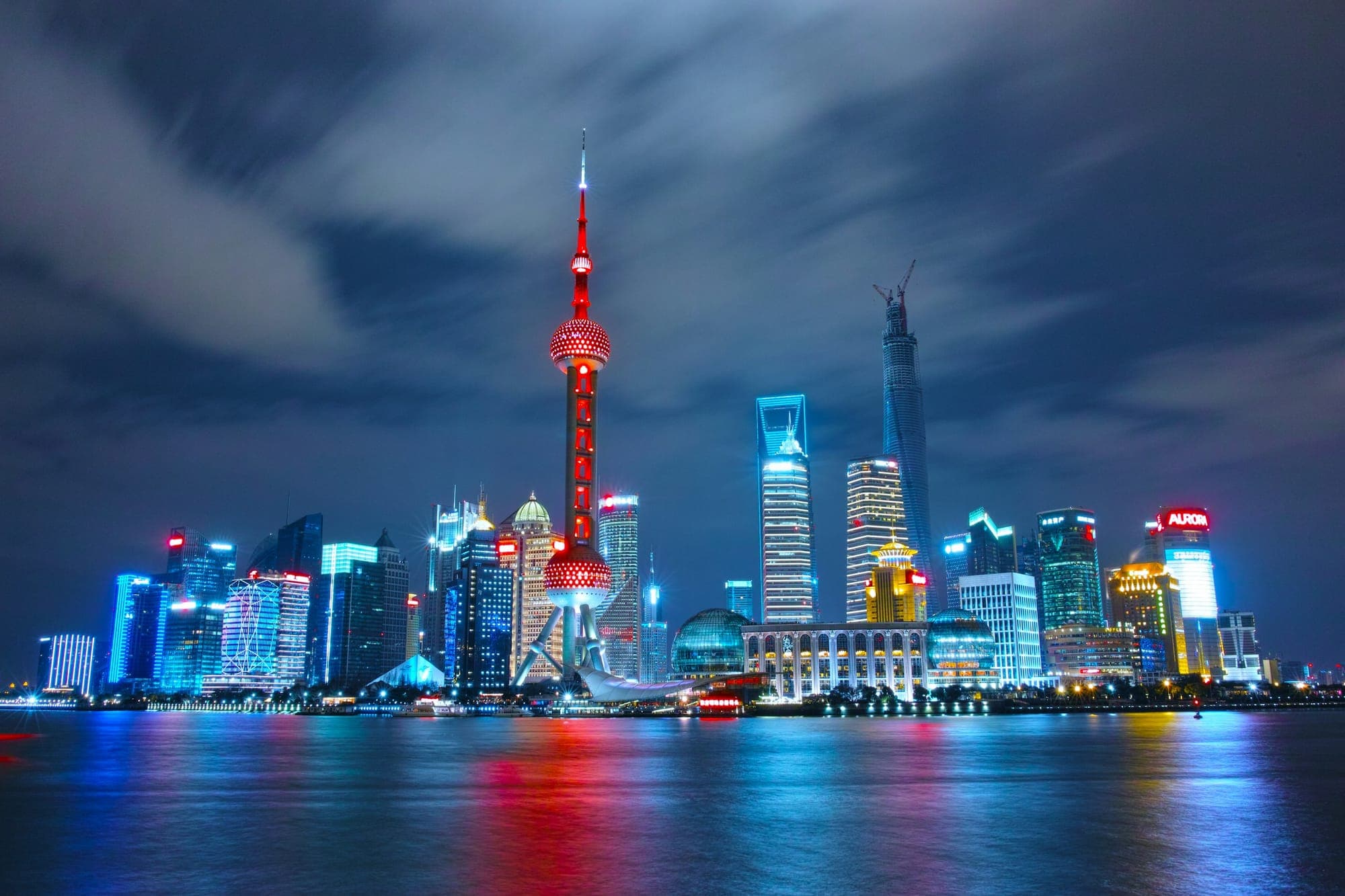
You land in Shanghai and you stay in the east. The city is for a neighborhood walk and a tea house, not a skyline scorecard. Suzhou is a short high-speed hop: one garden, then the streets that still use it. Hangzhou is the tea hills, Longjing in the morning, West Lake at an hour when the path is not a queue. The extra is Nanjing — a wall, a museum, or one street — or Huangshan if you want stairs and weather more than a city. You do not try to "do China." You walk, you sit, you take the train when the light is used up.
This is the route we give people who want pictures they will keep, and a cup they can talk about, more than a list they can post.
2. North-to-east HSR
Beijing, Xi'an, Shanghai. One deep day in each city, not twelve attractions. The trains are the spine.
Beijing is hutongs and one palace morning, not a flag-and-bus circuit. Xi'an is the wall at a quiet hour, or one museum you actually finish — not a terracotta-and-out dash. When you do schedule the mausoleum, use How to Visit the Terracotta Army in Xi'an 2026 for booking and transport. Shanghai is streets and a river evening, not a Bund pose list. You will skip more than you see. That is the point of ten days on a transit clock. The high-speed legs eat half a day each. Plan the trains as rest, not as a race.
Use this route if you already know you want north and east in one stamp. Do not add Chengdu or a fourth city to "get more China." You will lose the deep day.
East China, day by day
This table is a sample, not a package. Swap Hangzhou for a second Suzhou day if you want less moving. Swap Nanjing for Huangshan if the weather holds and you accept an early start.
| Day | Base | The day |
|---|---|---|
| 1 | Shanghai | Land. Hotel. One evening walk by the river. Sleep. |
| 2 | Shanghai | One neighborhood on foot. A tea house. Photograph streets, not a skyline list. |
| 3 | Suzhou | Morning high-speed rail. One garden, then the lanes around it. |
| 4 | Suzhou | Canal morning, or a silk or tea session. Stay put. |
| 5 | Hangzhou | High-speed rail. West Lake at a quiet hour. |
| 6 | Hangzhou | Longjing hills. Walk, taste, sit. |
| 7 | Nanjing | High-speed rail. One wall, one museum, or one street. Not all three as a race. |
| 8 | Nanjing | A slower second day, or start back toward Shanghai. |
| 9 | Shanghai | Buffer. Last photographs. Recheck the onward ticket and the clock. |
| 10 | Exit | Leave for the third country or region inside the 240 hours. |
Day 9 exists so a delayed train does not eat the onward flight. Do not book a tight domestic hop on the last morning.
Day 1 is not a sightseeing day. Airport, data, Alipay, hotel, sleep. If you land after 22:00, skip the evening walk. Day 2 is one neighborhood on foot, and it doubles as practice for the metro QR and the shop scan. In Suzhou, one garden a day is enough; Day 4 is the stay-put day. If rain takes the Longjing hills on Day 6, sit by the lake and move the hills to the next morning. Weather is not a failure.
Trains and a wallet, a week out
Buy the trains as set out above, on 12306 with the same passport. This page will not invent a 2026 fare, a train number, or a taxi minute count. Check today's trains on 12306. The English homepage states ticket sales from 05:00 to 01:00 the next day (05:00 to 23:30 on Tuesday). Arrive with time: the entrance, the security check, the gate and the platform sit a walk apart.
Set up Alipay and WeChat Pay a week before you fly. Alipay first. WeChat Pay often needs one to three business days after the passport check. Street stalls and metro gates take a QR, not a chip card. Do not start this on airport Wi-Fi.
What LocalKey will book, and what we will not
Your own China trip, planned, booked and backed, in two private ways. Independent: flights, hotels, trains, transfers, an app roadbook, and a WhatsApp or WeChat thread. You walk the city. You ride the metro. You choose the restaurant. A local guide is an optional add-on on demand, useful for a museum morning, not for a train day. Private Guided: the same plan, with private guides and a car across the trip.
The same days work in either lane. What changes is how you move and how much support sits around you:
| Independent | Private Guided | |
|---|---|---|
| Movement | Rail-led, you ride the high-speed trains yourself | More private car days, fewer transfer logistics |
| Guide time | Local guide as an optional add-on on demand | Private guides across the trip |
| Pace | Efficient | Slower where jet lag, luggage or mixed ages call for it |
| Shared | 1:1 specialist design, bookings, app roadbook, 7×24 WhatsApp or WeChat | Same |
The Independent and Private Guided details sit on the private tours page. International flights are optional: we can book them with the trip, quoted separately, or you book your own. Insurance, personal documents and personal spending stay with you unless we arrange them. Travelling with children or older parents? Fewer hotel changes matter more than city count; start on family China tours.
We will not put you on a coach. We will not sell a first-timer Shanghai-plus-Suzhou toolkit as if it were the whole country. We will not turn the Forbidden City, the Terracotta Army, and the Bund into the pitch. Depth first. Checklist last.
LocalKey is the visitor brand of Guangdong Xingcheng International Travel Agency, established in 2009. Budget is flexible — spend as much or as little as you like. Public transport and mid-range hotels, or a car and the room you actually want. There is no group rate hiding in the middle.
Send the passport country, the entry port, the onward city, and which of the two routes you want to bend. We design from there.