Cantonese morning tea, or yum cha, is a sit-down meal at one tea-house table in Guangzhou: order a pot of tea first, then two or three plates of dim sum, and stay for a second pour. It is not a walking food tour or a ranked list of houses, and you do not need a group yum-cha coach to eat it.
Guangzhou wrote the meal into local law in 2026, and Guangdong already lists the Cantonese tea-drinking custom as provincial intangible heritage. This page covers how to sit and order, what the 2026 rules mean at the table, and how the same meal works if your first Cantonese table is outside Guangzhou.
What is Cantonese morning tea, and how is it different from a food tour?
Cantonese morning tea is tea paired with Guang-style pastries, eaten at one table over a long sit; Guangzhou's 2026 regulation defines it as a dining form, not a tour. A food tour is a locked walk from kitchen to kitchen; yum cha is one room, one pot and a few small plates.
The search "Cantonese food" or "Guangzhou food" is usually a checklist. The meal people actually sit for is yum cha in a tea house. China Daily still writes the local phrase yī zhōng liǎng jiàn, one pot of tea and two dim sum dishes (Yum cha, the Guangdong way). The Guangzhou municipal portal puts the difference plainly: morning tea is not breakfast. Breakfast can be quick; morning tea needs tea, the gear and time, sometimes a few hours.
Guangzhou's Morning Tea Inheritance and Protection Regulation was passed by the Guangzhou People's Congress Standing Committee on 21 January 2026, approved by the Guangdong People's Congress Standing Committee on 26 March 2026, published on 1 April 2026 and in force from 1 May 2026. The Guangzhou Culture, Radio, Television and Tourism Bureau called it the first special local regulation in the country written for morning tea. Article 2 defines the meal as produced, developed and popular in the Guangzhou area, with tea paired with Guang-style pastries as the core form, fusing Lingnan food culture, social custom and traditional skill. The bureau note is careful on scope: the law protects that tea-house form and does not try to police every weekday breakfast.
Guangdong had named the custom earlier. On 29 April 2022 the provincial government approved the eighth batch of provincial intangible-heritage representative items, 43 new listings, in Yue Fu Han (2022) No. 67, and the government reading of that notice names the Guangfu tea-drinking custom among them, with dim sum as part of the sit. That is a provincial listing; this page does not upgrade it to a national or world-heritage one. The province also passed a cuisine law: the Guangdong Cuisine Development Promotion Ordinance, passed on 30 November 2022 and in force from 1 January 2023, the first provincial-level cuisine statute in the country, treats Cantonese cuisine as industry, skill and culture.
How do foreigners order yum cha without speaking Chinese?
Walk in, take an empty table, and point: first at a pot of tea, then at two or three small plates such as har gow, siu mai and rice noodle rolls. Pay by QR code with Alipay set up before you go, and confirm the day's price on the menu.
If no server comes, walk to the counter and point. Saying yum cha or morning tea is enough. If the house charges a tea-position fee, the 2026 regulation says it must offer black, green, oolong, pu'er and chrysanthemum tea, so point at one of those. This page does not invent English names for house blends or a 2026 pot price.
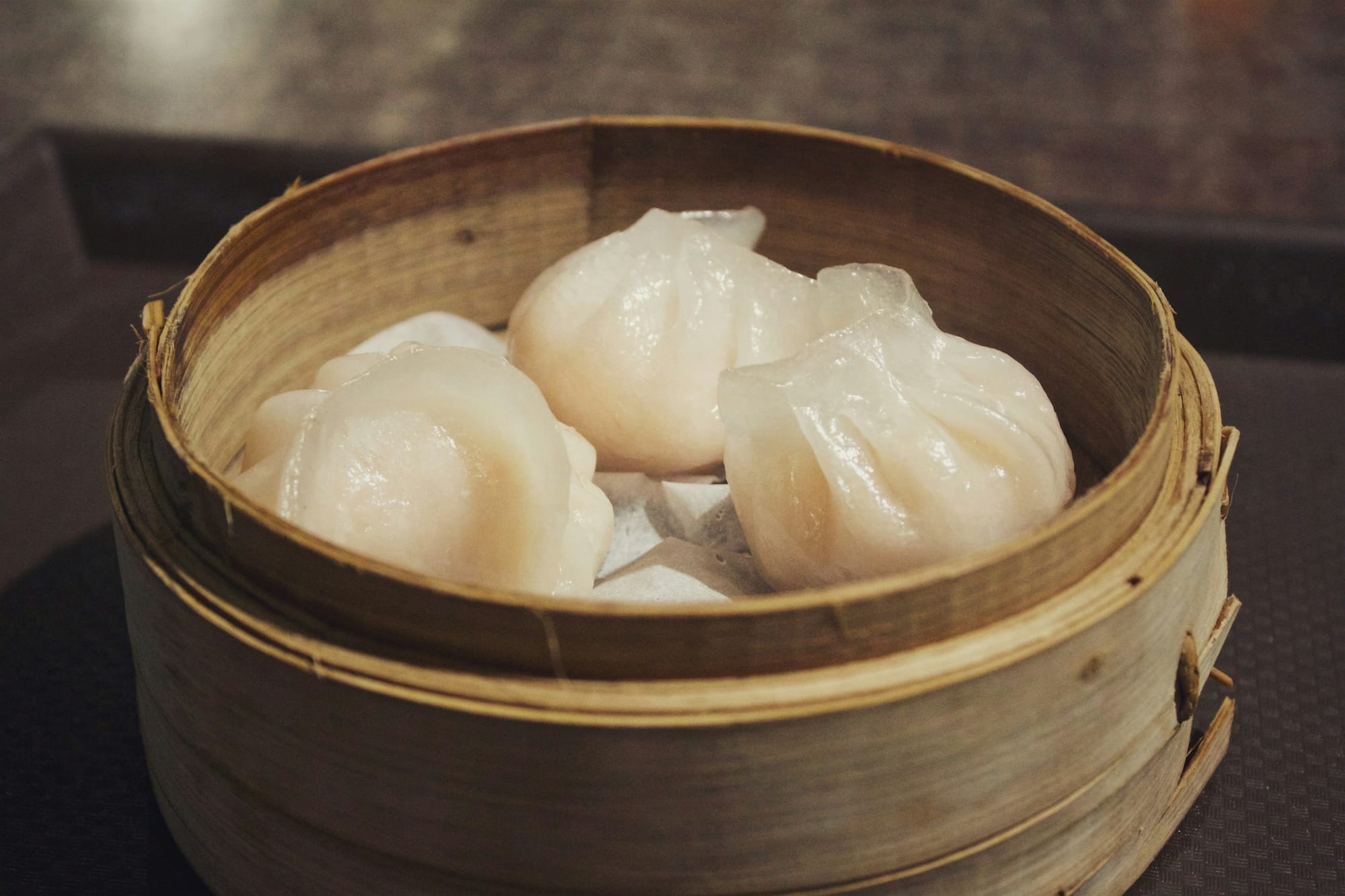
Har gow, the shrimp dumpling in a thin, clear wrapper, is the usual benchmark; China Daily quotes a Guangzhou hotel chef on its classic 13 pleats (China Daily). Siu mai sits next to it, and rice noodle rolls often follow. Order two or three plates, not twenty, and stay for the second pot. Photograph the steam if you want a picture, but do not pose over a cart you did not eat from.
Pay by QR. Set up Alipay for foreigners before you want tea, not when the first plate is on the table. You do not need a Chinese bank card. Cash still appears at some older rooms; do not count on it.
What do Guangzhou's 2026 morning-tea rules mean at the table?
They give you three things to look for: a tea-position fee is only lawful if the house actually serves tea, traditional dim sum must be marked as made on site the traditional way or not, and traditional pieces must reach the table within 24 hours of being made. None of this is a restaurant ranking, and this page names no house as the pick.
| On the table | What the official rules say | What you do |
|---|---|---|
| Pot of tea | Core form: tea paired with Guang-style pastries | Order the pot first. Stay for a second pour. |
| Tea-position fee | If charged, the house must serve tea and offer black, green, oolong, pu'er and chrysanthemum | Confirm the day's menu and point at one leaf. |
| Small plates | Guang-style pastries; the provincial reading calls dim sum part of the custom | Order two or three to start. |
| Traditional mark | Operators must mark traditional on-site making versus non-traditional making | Read the mark; it is a consumer right. |
| 24-hour window | Traditional pieces: not more than 24 hours from making to serving, unless the craft itself needs longer | Treat it as a freshness rule, not a timetable. |
| Open kitchen | Houses should show pastry making through a visible, open or monitored kitchen | Watch if the room offers it; do not walk into a kitchen you were not invited into. |
Sources for the table: Guangzhou Morning Tea Inheritance and Protection Regulation; Guangzhou municipal portal, 3 April 2026; Guangzhou culture bureau note, 3 April 2026.
The same law lets market supervision run a voluntary, free "traditional morning-tea shop" evaluation. A plaque from that process is not a ranking, and this page does not reprint one. Pick one room that already makes tea and small plates, and sit.
Can you eat Cantonese dim sum outside Guangzhou, for example in Shanghai?
Yes. If your first landing is Shanghai, a yum cha table there is the same sit-down meal, tea first and then a few dim sum, but Guangdong remains its origin and Guangzhou its home city. Keep it as a slow morning in the city you are already in rather than adding a city for it.
On a first landing, yum cha fits the slow morning of the first 24 hours in Shanghai, not a food-tour loop of ten kitchens. If your route already goes south, keep the Guangzhou tea house for that week.
Do not confuse this table with other tea rooms. Sitting with a pot of green tea on a hillside is West Lake Longjing 2026; Chengdu's park bowl is Chengdu teahouse experience 2026. UNESCO's 2022 listing of traditional tea processing techniques and associated social practices in China includes the pastries served with tea, and Chaozhou gongfu tea is Guangdong's thread on that list. It is also not Shanghai's sealed-soup steamer: Nanxiang xiaolongbao is thin skin and soup, while morning tea is a pot and a spread of small plates. For the wider Lingnan picture of halls, opera and river-delta towns, see Guangdong Lingnan culture.
How this sits in an Independent or Private Guided week
Morning tea does not need its own coach day. It fits a Guangdong week you already chose, such as a first morning after you land in Guangzhou, or a Shanghai morning on an east-China route like our 10-day itinerary. Book any intercity seat on official 12306 with the same passport you carry to the gate; the how-to is 12306 train tickets for foreigners. If you are on the 240-hour visa-free clock, Guangdong is among the stay regions named by the National Immigration Administration; check the NIA English policy the week you book.
LocalKey does not sell group food tours or yum-cha coaches. We plan your own China trip, planned, booked and backed, in one of two private ways. Independent: we book the hotels and trains, you get the LocalKey app roadbook and a 24/7 WhatsApp or WeChat thread, and you can add an airport pickup, a car and driver, or a local guide on the days you want one. Private Guided: the same planning, with private guides, a driver and a car across the trip. If the search you typed was a group query, read China group tours or a custom trip.
LocalKey Travel is the visitor brand of Guangdong Xingcheng International Travel Agency (est. 2009). Send a travel enquiry or see private China tours.
Official sources
- Guangzhou Morning Tea Inheritance and Protection Regulation
- Guangzhou municipal portal: morning-tea law note, 3 April 2026
- Guangzhou culture bureau: first special morning-tea regulation, 3 April 2026
- Guangdong Provincial Government: eighth provincial ICH batch, Yue Fu Han (2022) No. 67
- Guangdong government reading: Guangfu tea-drinking custom in the eighth batch
- Guangdong Cuisine Development Promotion Ordinance
- UNESCO: Traditional tea processing techniques and associated social practices in China
- China Daily: Yum cha, the Guangdong way