Updated 13 October 2026 · LocalKey consultant team
We suggest three nights in Lijiang, or four or five if you add Tiger Leaping Gorge or a slower day in Baisha. Spend your first night or two in Dayan old town and the rest in Shuhe, give Jade Dragon Snow Mountain one early morning, and book its gate ticket and cableways up to 7 days ahead on the official channels, because bookings are real-name and the Glacier Park cableway is tight in peak periods.
How many days do you need in Lijiang?
We suggest at least three nights (about three to four days on the ground), or four or five nights if you add the gorge or want a slower Baisha day.
We usually plan the old-town walks for dawn and dusk, and give Jade Dragon Snow Mountain one morning. Keep one flexible spare day, because cableways can stop or slow in strong wind or heavy rain. As a pacing sketch for three nights, treat the first evening as a gentle arrival in Dayan, give the second morning to the mountain and keep the afternoon free to rest at altitude, and use the third day for Baisha or Shuhe with a light departure day.
If you stay four or five nights, we suggest adding the gorge as its own day rather than squeezing it between other plans. Our page on Tiger Leaping Gorge Hiking 2026 is the place to start. If you would rather stay with the town, we suggest a slower day in Baisha and a second quiet evening in Shuhe.
Yunnan Province is one of the 24 permitted provincial-level areas for the 240-hour visa-free transit, so eligible nationals of 57 countries who are flying on to a third country or region can include Lijiang in a stay of up to 10 days. Our 240-hour visa-free China guide explains the rules, and we suggest reading it before you fix your dates.
Should you stay in Dayan old town, Shuhe or Baisha?
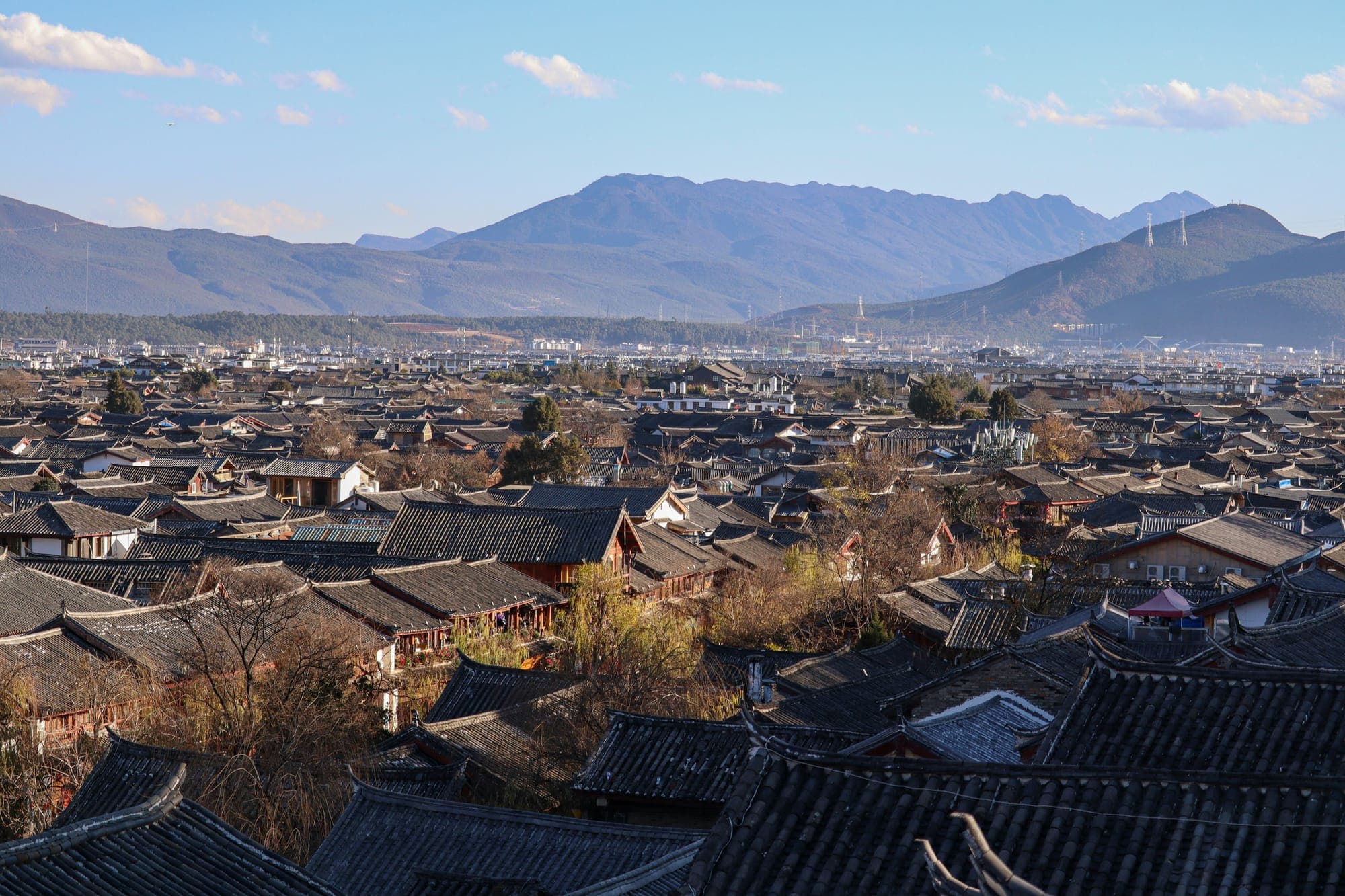
The old town has three components: Dayan Old Town, the Baisha housing cluster and the Shuhe housing cluster. We suggest Dayan for one or two nights, for the old-town lanes, and Shuhe for calmer nights after that.
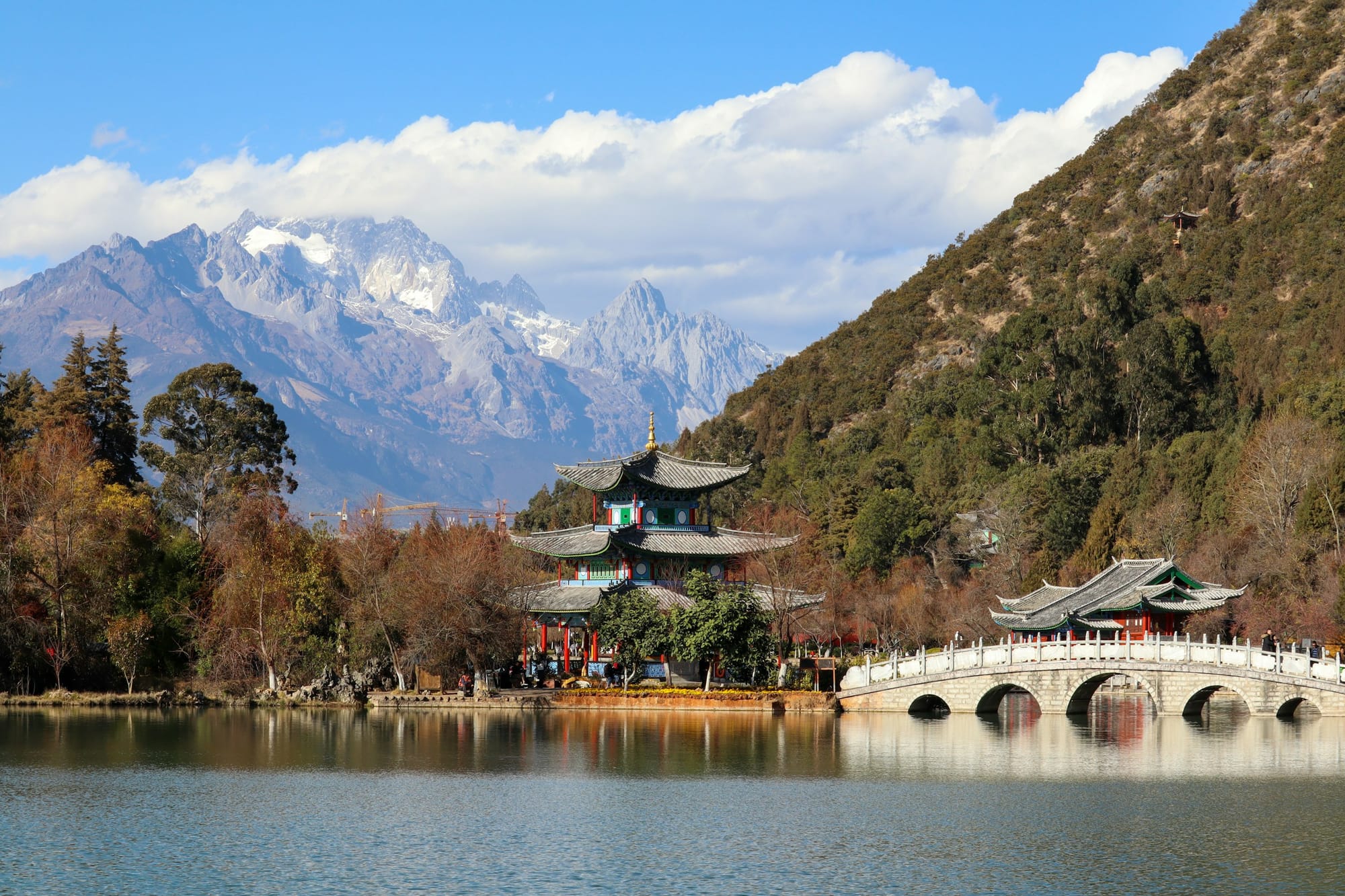
The town sits on the Lijiang plain at 2,400 m in Yunnan. UNESCO inscribed the old town in 1997. Yulong (Jade Dragon) Snow Mountain feeds the springs of the Heilong Pool (Black Dragon Pond), whose waterways run through the town in canals crossed by many bridges. The ancient water-supply system still functions. For some 800 years the town has been a centre of exchange between the Naxi, Han, Tibetan and Bai peoples, where the southern Silk Road joins the Ancient Tea and Horse Road.
Dayan Old Town is the Ming-era commercial centre and includes the Black Dragon Pond, so it suits a first stay of wandering the lanes. Baisha is 8 km north of Dayan, has Song–Yuan origins and murals from the early 13th century, and we usually plan it as a morning visit rather than a base. Shuhe is 4 km north-west of Dayan, and we suggest it for a quieter base for the rest of your stay.
Moving from Dayan to Shuhe halfway through means one change of lodging; if you prefer to unpack once, tell your specialist and we will plan a single base with day visits. We suggest deciding by what you want from the evenings: Dayan for the lanes and canals, Shuhe for a calmer end to the day.
For more UNESCO detail, read Lijiang Old Town 2026. Dongba culture, the Naxi script and traditional house-building skills are on our Dongba culture in Lijiang page.
How do you book Jade Dragon Snow Mountain in 2026?
Book the scenic-area gate ticket up to 7 days ahead on the official "Jade Dragon Snow Mountain Service" WeChat mini-program or at the new visitor service centre in Baisha, and book optional cableways up to 7 days ahead on the official "Lijiang Tourism Group" WeChat mini-program. Bookings are real-name with face checks, and LocalKey can book them for you.
The Yulong Snow Mountain Management Committee's notice dated 16 July 2026, published by Xinhua Yunnan, says the area opens daily from 05:45 to 16:30, and that peak periods run on limited numbers, reservation and staggered time-slot entry. Two basic tickets are required to enter: the scenic-area gate ticket and the eco-shuttle bus ticket.
| Ticket | How it is sold | Rule to know |
|---|---|---|
| Scenic-area gate ticket (required) | Real-name booking up to 7 days ahead on the official "Jade Dragon Snow Mountain Service" WeChat mini-program, or at the new visitor service centre in Baisha | Required to enter; in peak periods entry is by time slot |
| Eco-shuttle bus ticket (required) | Named in the notice as the second required ticket | The gate ticket and the eco-shuttle ticket are the two basic tickets needed to enter |
| Glacier Park cableway (optional) | Real-name booking up to 7 days ahead on the official "Lijiang Tourism Group" WeChat mini-program; face checks to buy and to board | Cableway rules: one ID can buy once in 90 days, and at least half of daily tickets go to independent visitors; Glacier Park tickets are tight in peak periods and cannot meet all demand |
| Spruce Meadow (Yunshanping) cableway (optional) | Same official mini-program and face checks as the Glacier Park cableway | Same cableway rules: one ID once in 90 days; at least half of daily tickets go to independent visitors |
| Other optional extras: the show, carts and the sightseeing train | Optional products named in the notice | Optional; you do not need them to enter |
The cableway company has not authorised any online platform to sell cableway tickets directly, so we suggest using only the official mini-program. The bookings are real-name with face checks, and LocalKey can book them for you.
Because the gate ticket and cableway tickets are sold up to 7 days ahead, we suggest choosing the mountain day before anything else in the week. If the Glacier Park cableway is your priority, tell us early, since its tickets are tight in peak periods. The Spruce Meadow (Yunshanping) cableway is the other option.
The mountain area is high altitude with large day-night temperature swings, so we suggest you rest before going up. The notice says free hot drinks and blood-pressure and blood-oxygen checks are offered at Ganhaizi and at the cableway stations. Do not enter undeveloped or unopened areas: rescue there is difficult, and violators are held legally responsible.
For the day itself, we suggest bringing layers you can add and remove, a small bag, and a flexible plan if cableways stop or slow in strong wind or heavy rain. Bookings are real-name with face checks, and LocalKey can book them for you.
How do you get to Lijiang and where can you go next?
The 139 km Lijiang–Shangri-La railway opened on 26 November 2023, and the Government of China says the fastest journey takes 1 hour 18 minutes. The line links Shangri-La to Kunming via the existing line through Lijiang, and train tickets are sold on China Railway 12306.
We suggest checking 12306 as soon as your dates are fixed. As LocalKey routing advice, we usually keep Lijiang and Shangri-La together as one leg, then take in Dali and Kunming. The wider Yunnan loop is on our Yunnan, China 2026 page.
On pacing, we suggest not stacking a long travel day directly before your mountain morning. Arrive with a quiet first evening in Dayan, keep the early mountain start for the day after, and leave margin before any onward train.
For the gorge itself, see Tiger Leaping Gorge Hiking 2026. For an overview of the city, see the Lijiang destination page. When you write to a specialist, say which cities you want before and after Lijiang and whether you prefer rail, so we can build one connected trip.
Plan your trip with LocalKey
LocalKey can arrange this trip through private China tours. Both options are your own China trip — planned, booked and backed:
- Independent (see the details): you travel on your own with the LocalKey app and 24/7 backup. There is no full-time guide on any day, and a local guide, airport pickup or a private car and driver are optional add-ons on demand.
- Private Guided (see the details): a private guide and a private car throughout the trip.
Talk to a 1:1 specialist, available 7×24 on WeChat or WhatsApp, to choose the right base and have your Jade Dragon Snow Mountain tickets booked. We suggest opening with your dates, group size and the one thing you most want from Lijiang.
Sources
- UNESCO World Heritage Centre — Old Town of Lijiang — verified_on 2026-10-13
- Xinhua Yunnan — Yulong Snow Mountain Management Committee notice on Jade Dragon Snow Mountain, 16 July 2026 — verified_on 2026-10-13
- Government of China — Lijiang–Shangri-La railway opens, 26 November 2023 — verified_on 2026-10-13
- National Immigration Administration — Visa-Free Transit Policies, 20 August 2026 — verified_on 2026-10-13
- National Immigration Administration — 240-hour transit permitted areas, 19 December 2024 — verified_on 2026-10-13