Updated 16 October 2026 · Frank Zhang
Shu embroidery is a national intangible cultural heritage craft (item VII-21, first batch 2006) from Chengdu with twelve major stitch families; we suggest watching or buying at a working studio or at the officially named Anjing Shu embroidery cultural creative park in Pidu District, rather than at a shopping-circuit stop.
How do you see Shu embroidery in Chengdu in 2026?
Shu embroidery, also called Chuan embroidery, is listed as national item VII-21 and was declared by Chengdu, Sichuan. In 2026 we suggest seeing it in one of two ways: at a working studio in the city, or at the Anjing Shu embroidery cultural creative park in Pidu District, which the Sichuan Culture and Tourism Bureau names among places developed for interactive experience and craft display.
The table below sets out what the two sources we cite actually support, and what we suggest on top of that. The suggestions are our advice, not official guidance.
| Way to see it | What the sources support | What we suggest |
|---|---|---|
| Working studio in Chengdu | The listing's protection unit is the Chengdu Intangible Cultural Heritage Protection Center (Chengdu ICH Art Research Institute). The Bureau also mentions industry platforms in Chengdu. | Ask your consultant to name a studio where you can watch stitching, rather than picking a shop from a map. |
| Anjing park, Pidu District | Named officially among places for interactive experience and craft display. | Treat it as a dedicated outing for watching, trying and buying. Confirm opening details before you go. |
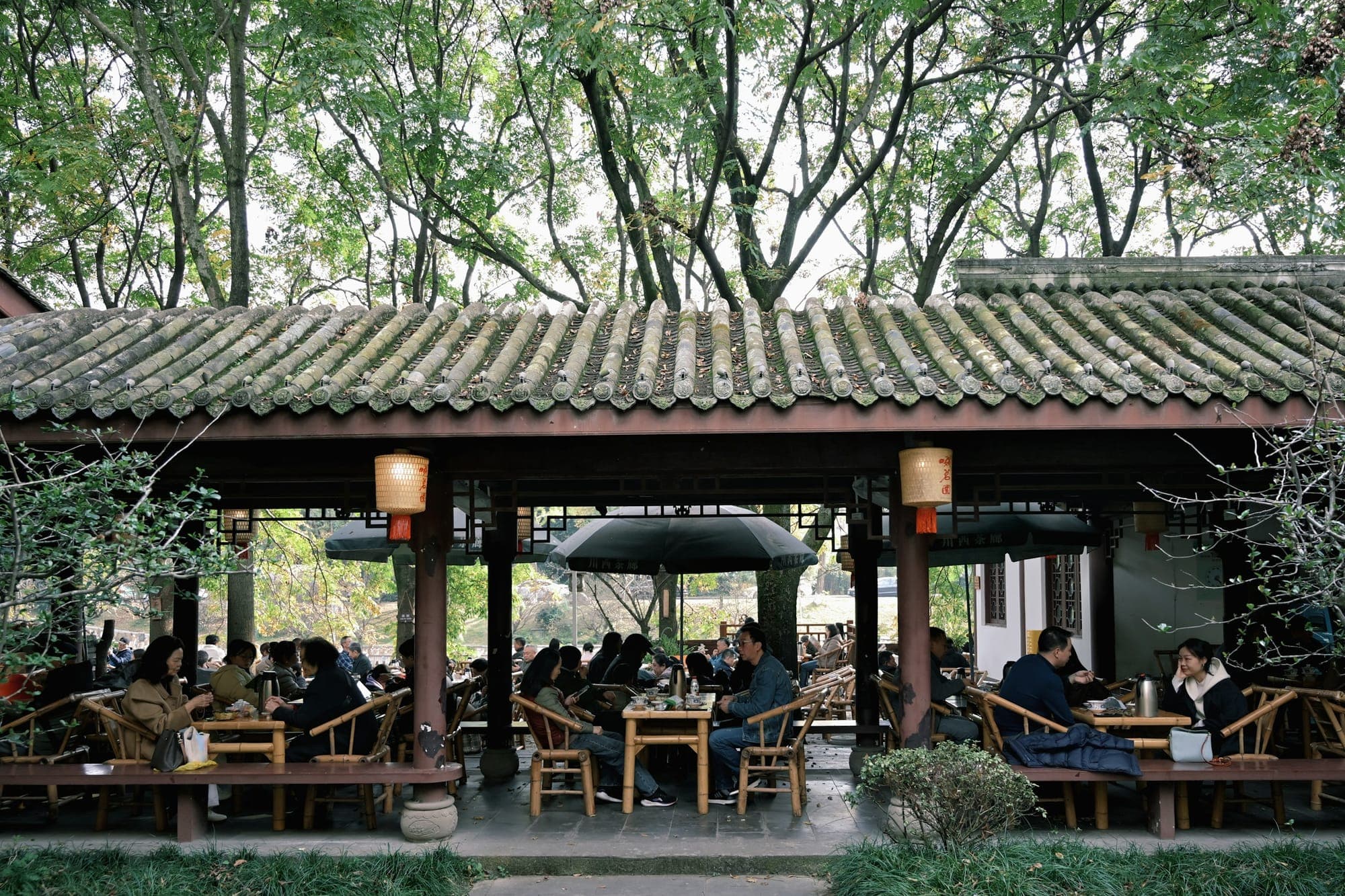
| A teahouse stop afterwards | Not part of the listing. It is a separate Chengdu topic. | Add a slow teahouse hour after the craft visit so the day does not become a run of shops. |
| The listing as background reading | Item VII-21, serial 320, first batch 2006, traditional fine arts category. | Read the stitch-family outline in the next section before you arrive, so the demonstrations make sense. |
A craft visit works best when you go to see how the work is made. Silk embroidery is slow, so the useful questions are about process: what the ground fabric is, which stitch family a piece uses, and how long a piece takes to finish. The listing says Shu embroidery grew from folk practice in western Sichuan and used local satin and loose thread. Asking about materials is a good way to start a conversation, even through an interpreter or a translation app.
If you want to buy something, we suggest deciding first what you are looking for. A small framed piece, a scarf or a larger panel will each give you different things to ask about. We do not rank shops or name a "best" place to buy, and we do not give prices here. Prices change and we have not verified any for 2026. Ask the person who made or supervises the piece to tell you about it before you ask about cost.
For paying in China as a visitor, see our Alipay for Foreigners page. It is worth sorting out before a day with a purchase in it.
What makes Shu embroidery distinct?
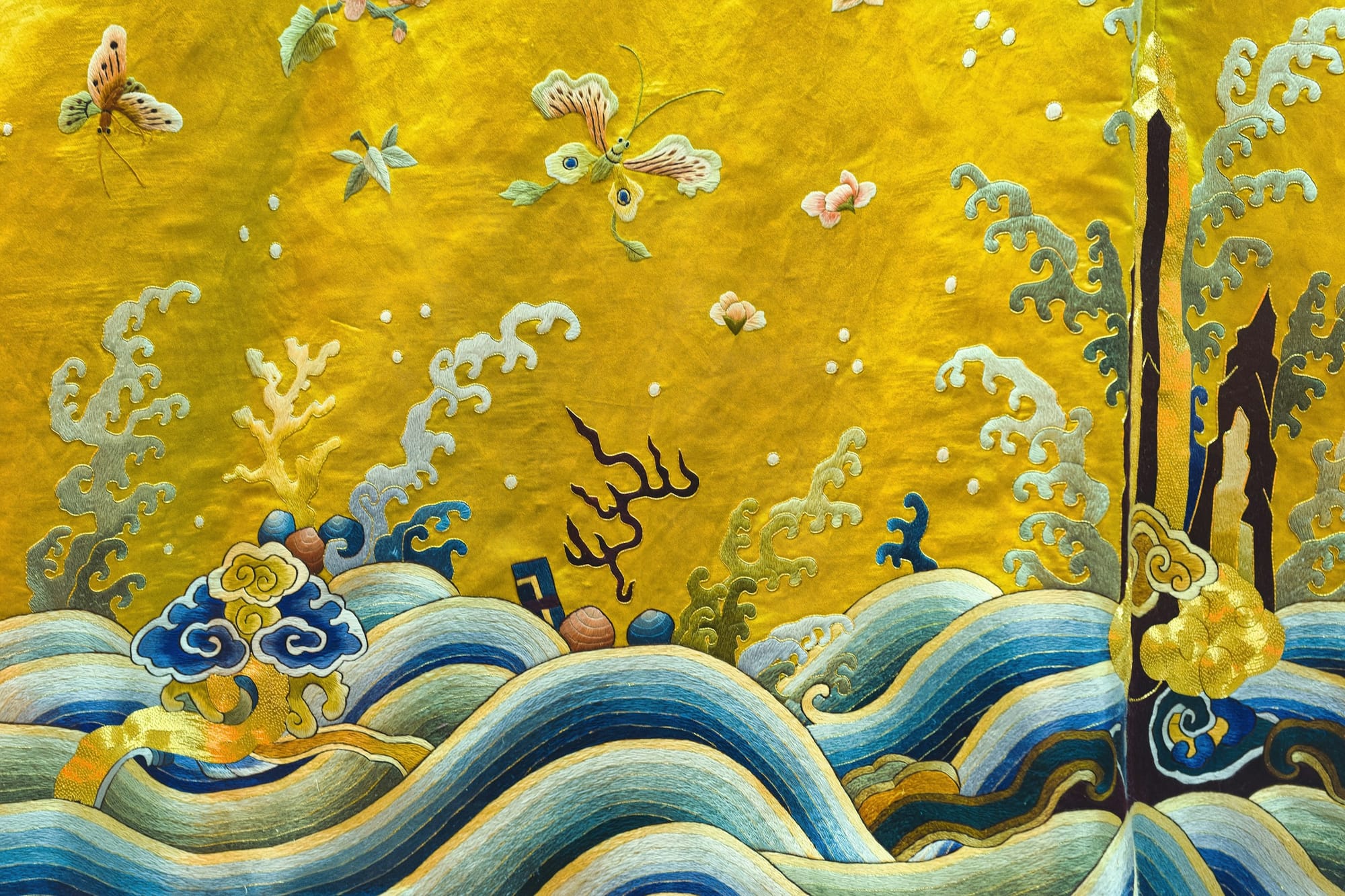
Shu embroidery is described on the national listing as having twelve major stitch families and 122 named stitches, with a style that is rigorous and fine, bright and even. The same listing uses the words sparse composition, thick and rounded forms, and clear, bright colour.
Those words are the most reliable way to look at a piece. We suggest using them as a short checklist when you stand in front of a panel:
- Rigorous and fine: look at how closely the stitches sit together and whether the surface looks controlled.
- Bright and even: look at whether the colour and the sheen stay steady across an area.
- Sparse composition: notice how much empty ground the design leaves.
- Thick and rounded forms: notice whether the subject feels full and rounded rather than flat.
- Clear, bright colour: compare how clean the colour changes look from one area to the next.
The listing also gives the craft's formal details. It is item VII-21 (serial 320) in the first national batch of 2006, under the category of traditional fine arts. Chengdu, Sichuan, declared it. The protection unit is the Chengdu Intangible Cultural Heritage Protection Center, also given as the Chengdu ICH Art Research Institute. The listing's place frame is Chengdu and the western Sichuan plain, which is where the folk practice behind the craft began.
We do not describe individual stitches or teach how to make them here, because the sources we use give the counts and the style words, not technique steps. If you see a stitch family named in a studio, ask the person to show you where it appears in the piece. That is better than relying on a list from us.
Shu embroidery is a separate tradition from the better-known embroidery of Jiangnan. If your route also takes you east, our Suzhou Embroidery 2026 page covers that craft on its own terms. We do not compare them stitch by stitch here, because the point of a visit to Chengdu is to look at Chengdu's craft in its own setting.
Where is Anjing, and how do foreigners visit?
Anjing is in Pidu District, and the Sichuan Culture and Tourism Bureau names the Anjing Shu embroidery cultural creative park among places developed for interactive experience and craft display. We use it here only as the officially named park for watching, trying and buying Shu embroidery.
That is the extent of what the official source tells us, and we stay inside it. The sources do not give opening days, entry rules, workshop formats, transport details or any visitor price, and a local chronicle page we tried to check for more on Anjing did not load, so we have added nothing from it. We do not publish those details as facts for 2026. We suggest you confirm them through your consultant or the park itself before you set a date.
For a visitor without Mandarin, the practical approach is simple preparation:
- Have the park's name saved in pinyin and, through your consultant, as a copy a driver or taxi can read.
- Decide in advance whether you want to watch, try or buy, because a park built for interactive experience may offer different things on different days.
- Keep a translation app ready for questions about materials and stitch families.
- Set up mobile payment before the day. Our Alipay for Foreigners page explains the steps.
Pidu District is a separate part of the Chengdu area, so we suggest treating the visit as its own outing rather than squeezing it between city-centre stops. Plan the rest of the day around it.
A teahouse is a natural next stop, and it fits the pace of the day. Our Chengdu Teahouse Experience 2026 page covers how to approach one. Craft viewing is close work, and a long, slow cup of tea afterwards lets you go back over what you saw. For wider planning, see our Chengdu page.
Do you need a tour to see Shu embroidery?
No, you do not need a tour, but a visit is easier to do well when someone has sorted out the studio, the timing and the language in advance. Anjing and city studios are places you can plan around, and the question is how much of that you want to handle yourself.
LocalKey can arrange this as part of your own China trip — planned, booked and backed by us. It is not a group tour. We offer it in two forms.
- Independent: you travel on your own with the LocalKey app and 24/7 backup. There is no full-time guide on any day. A local guide, airport pickup, or a private car and driver can be added on demand. This suits visitors who are comfortable moving around and want help only where they ask for it, for example a named studio visit with a local guide for the craft part of the day.
- Private Guided: an English-speaking private guide and a private car throughout the trip. This suits visitors who want the language, the transport and the questions about the craft handled for them from start to finish.
Both are part of our private China tours. In either form, we suggest agreeing the craft visit in advance, so the studio or park, the date and the way you will pay are settled before you arrive in Pidu District.
Plan your trip with LocalKey
Shu embroidery works best as one slow day inside a longer Chengdu stay. LocalKey can help you decide whether that day is a studio visit in the city, an outing to Anjing, or both, and where a teahouse fits around it.
A 1:1 specialist handles your plan and is reachable 7×24 on WeChat or WhatsApp. Tell us your dates, how comfortable you are moving around China on your own, and whether you want to watch, try or buy. We will propose either Independent or Private Guided and confirm the details that this article does not give, such as opening days and transport, before you commit.
Sources
- China ICH Digital Museum — Shu embroidery — verified_on 2026-10-16
- Sichuan Culture and Tourism — Shu embroidery / Shu brocade reply — verified_on 2026-10-16