Updated 12 October 2026 · LocalKey consultant team
China's peak travel weeks are Spring Festival, the May Day holiday and the National Day week starting 1 October; in 2026 these ran 15–23 February, 1–5 May and 1–7 October under the State Council's holiday notice. We suggest avoiding them for a first trip, or booking trains, hotels and timed tickets as early as each opens.
Visitors often use "Golden Week" for the National Day holiday that begins on 1 October. In this article we use it loosely for all three peak holiday weeks, because they affect a trip in much the same way. In our experience, the places a first-time visitor wants to see are the same places domestic holiday travellers head for in those weeks.
When are China's Golden Week holidays?
A State Council General Office notice dated 4 November 2025 set the 2026 holidays: Spring Festival from 15 to 23 February (9 days), Labour Day (May Day) from 1 to 5 May (5 days) and National Day from 1 to 7 October (7 days). Mid-Autumn Festival 2026 was a separate holiday, on 25–27 September.
China's peak holiday weeks:
| Holiday | 2026 dates | Make-up working days | 2027 outlook |
|---|---|---|---|
| Spring Festival | 15–23 February (9 days) | Saturday 14 February and Saturday 28 February | Lunar New Year falls on Saturday 6 February 2027; official days off pending |
| May Day (Labour Day) | 1–5 May (5 days) | Saturday 9 May | Official days off pending |
| National Day | 1–7 October (7 days) | Sunday 20 September and Saturday 10 October | 1 October 2027; official days off pending |
The make-up working days are weekend days that were worked as normal working days to balance the longer break. They matter for planning because the weekends before and after a holiday are not always free time for local travellers. Check them before you assume a quiet Saturday.
The rules also changed recently. From 1 January 2025, according to english.gov.cn (Xinhua), the Spring Festival public holiday grew from three to four days, with the eve of Chinese Lunar New Year added. May Day grew from one to two days, with 2 May added. The same report says public holidays can be combined with adjacent weekends or paid annual leave to form longer holiday periods. It also says that, except in rare cases, working days around national holidays generally won't exceed six in a row. In practice, many people in China can stretch a short official holiday into a longer trip, and the travel period around each holiday can be wider than the official dates.
What do we know about the 2027 holiday dates?
For 2027 only the calendar dates are fixed: Lunar New Year is Saturday 6 February 2027, Mid-Autumn Festival is Wednesday 15 September 2027, and National Day is always 1 October. The official 2027 holiday schedule has not been published yet, so the number of days off and the make-up working days are not known.
The 2026 notice came out on 4 November 2025, and the 2027 notice has not been published yet. LocalKey will confirm the 2027 dates when the State Council publishes them, and we will update this page when that happens.
Until then, we suggest planning from the lunar and calendar dates and treating the days around them as busy. For the festival calendar, see Chinese Festivals 2027. For Spring Festival in particular, see Chinese New Year 2027 China Travel.
How crowded is China during Golden Week?
The 2026 Spring Festival travel rush (chunyun) ran from 2 February to 13 March, 40 days, and China State Railway Group expected the national railway to handle more than 539 million passenger trips in that period, according to the Shanghai Municipal Government English portal. That is the one hard figure we quote here.
For the other holidays we describe the pattern rather than put numbers on it.
Spring Festival is the clearest case. The rush is far longer than the nine-day holiday, so trains can be busy well before and after it. The same logic applies on a smaller scale to May Day and National Day.
What a visitor notices, in our experience of how these weeks work:
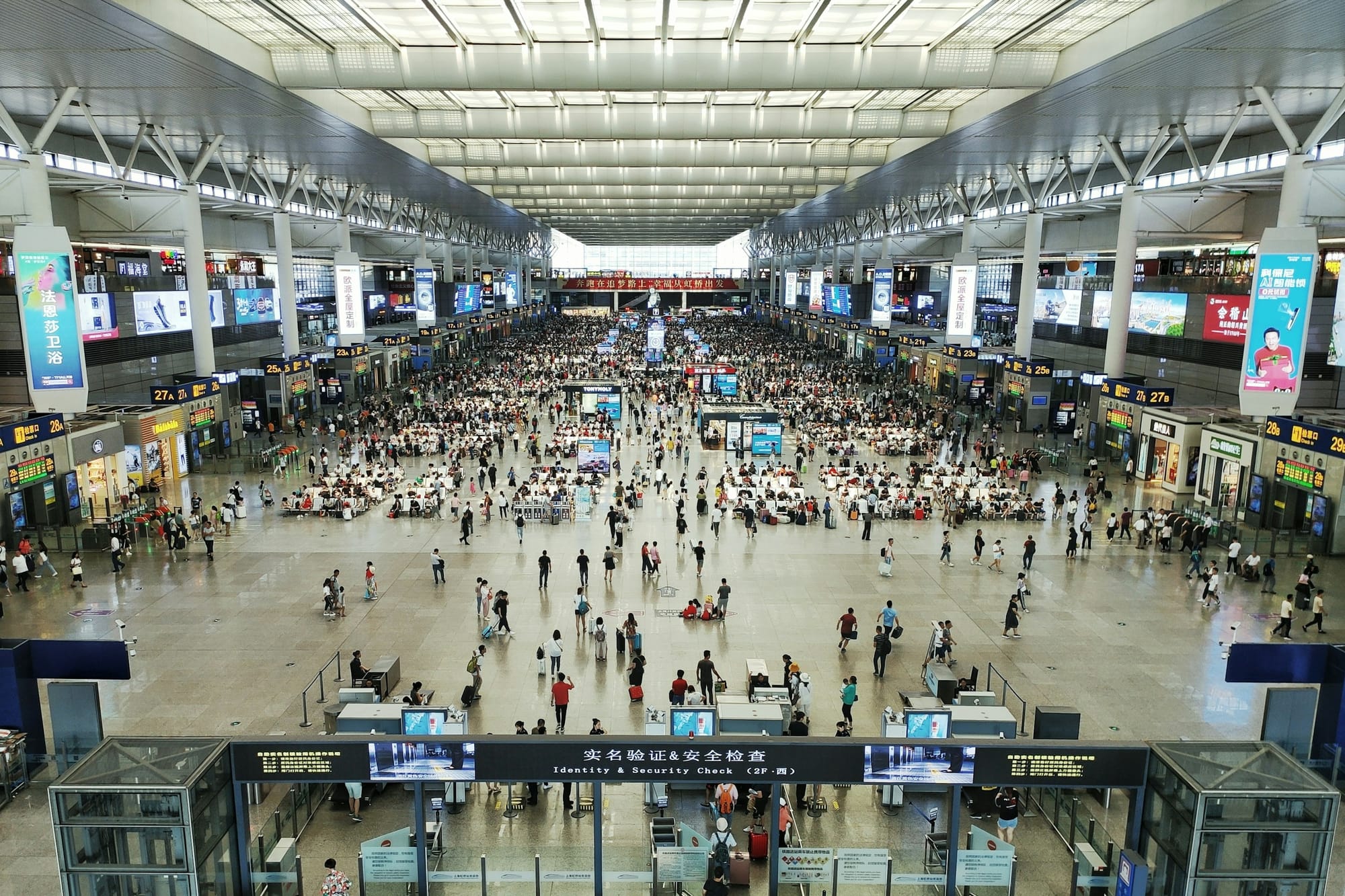
- Trains and stations. Queues are longer, popular departure times sell out first, and stations take more time to get through. Allow extra time for security and platform access.
- Big sights. Timed tickets and entry slots sell out sooner. We suggest visiting famous sites early in the morning.
- Hotels. Availability is tighter, especially near major sights and stations, and flexible options shrink as the dates approach.
- Roads and transfers. City traffic and airport approaches are slower, so a transfer that takes one hour on an ordinary day needs more margin.
None of this means a holiday-week trip is impossible. It means the trip needs more booking ahead and a looser daily plan. We suggest fewer stops per day and your most important sights early in the morning. If you only have those weeks free, plan for them rather than hoping for space on the day.
What should you book early for a holiday week?
Book the things that cannot be replaced at short notice: train seats, the first and last hotel nights, timed sight tickets and airport transfers. We suggest booking each item as soon as it opens.
- Trains. Train tickets go on sale up to 15 days before the departure date. You can buy at a station window with your passport, on the official China Railway website or in the China Railway 12306 app, where you can set the language to English after registering. For a step-by-step walkthrough, see our 12306 booking page. For which station serves which city, see our train stations page. We suggest having your passport details ready and logging in on the day the 15-day window opens for your route.
- Hotels. Book early and choose a location near a station or a metro line. We suggest keeping your first night and your last night before an international flight fixed, and leaving the middle flexible.
- Timed sight tickets. Where a sight uses timed entry, book the slot as soon as release opens and bring your passport. Have a back-up day in case a slot is full.
- Airport transfers. Arrange pickup and drop-off before you leave home, because taxi queues and road traffic are slower on holiday dates.
LocalKey can arrange the whole trip, including the bookings above, so you do not have to chase tickets in a second language. It is your own China trip — planned, booked and backed — and not a group tour. We offer two ways to do it through our private China tours:
- Independent: you travel on your own with the LocalKey app and 24/7 backup. There is no full-time guide on any day. A local guide, airport pickup or a private car and driver are optional add-ons on demand.
- Private Guided: an English-speaking private guide and a private car throughout the trip.
When should you travel instead?
If your dates are flexible, we suggest the weeks just outside each holiday period, and midweek days over weekends. Travel is still busy at the edges of a holiday, because people leave early and return late, so aim for a clear gap rather than the day before or after.
Mid-Autumn Festival is a separate short holiday. In 2026 it was a separate break on 25–27 September, just before National Day, and in 2027 it falls on Wednesday 15 September. Because the 2027 schedule is not yet published, we suggest checking the notice before you book anything around that date.
Which season suits you depends on where you are going, because weather differs widely between regions. Our when to visit China page covers the seasons city by city. If you must go in a holiday week, choose fewer cities, longer stays in each and trains booked on the first day they open.
Plan your trip with LocalKey
LocalKey can help you choose dates, work around the 2026 and 2027 holiday weeks and book the trains, hotels and timed tickets that sell out first. Talk to a 1:1 specialist on WeChat or WhatsApp, 7×24, and we will build the trip around your dates.
Sources
- State Council General Office (gov.cn) — 2026 holiday arrangements notice, 4 November 2025 — verified_on 2026-10-12
- english.gov.cn — China extends public holidays by two days, 12 November 2024 — verified_on 2026-10-12
- Hong Kong Observatory — Gregorian-Lunar Calendar Conversion Table of 2027 — verified_on 2026-10-12
- Shanghai Municipal Government English portal — Train ticket sales begin for Spring Festival travel rush, 19 January 2026 — verified_on 2026-10-12