Updated 16 October 2026 · LocalKey consultant team
The Longmen Grottoes are more than 2,300 caves and niches cut into limestone cliffs on both banks of the Yi River south of Luoyang; we suggest giving them an unhurried half day of their own rather than squeezing them between trains.
Longmen is a long, linear site rather than a single building, and it rewards a slow pace. This article covers what the UNESCO listing actually says, how to organise a first visit, how language and payments work for foreign visitors, and where a private trip plan can help.
How do you visit the Longmen Grottoes in 2026?
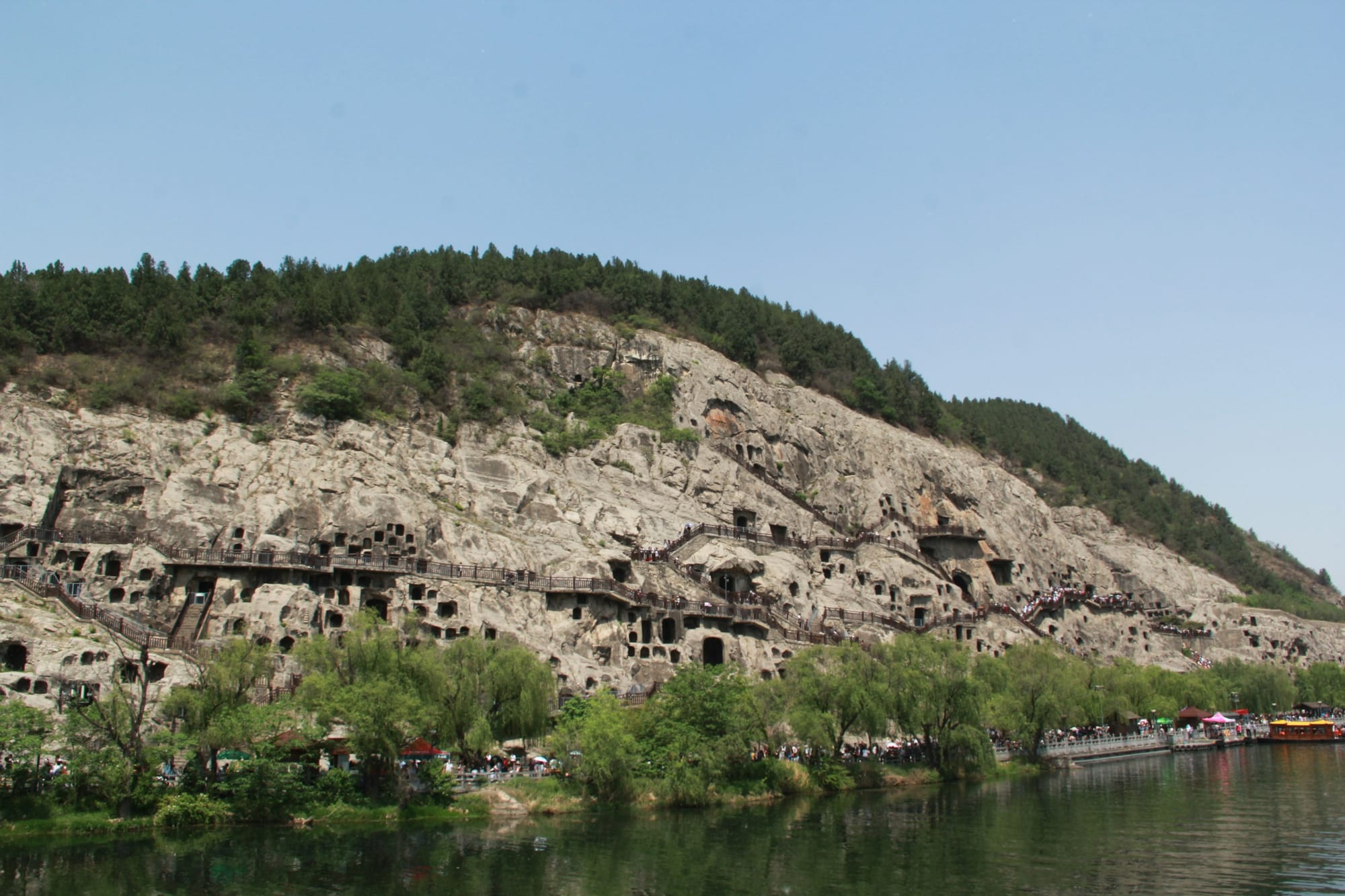
The Longmen Grottoes are in Luoyang City, Henan Province, on both sides of the Yi River, south of the ancient capital of Luoyang. UNESCO describes more than 2,300 caves and niches carved into steep limestone cliffs over a 1 km long stretch, so the visit is a walk along the cliffs on both banks, the West Hill and the East Hill, with the river between them.
China's National Cultural Heritage Administration (NCHA) places the site on both banks of the Yi River, at Longmen Mountain and Xiang Mountain, in Luoyang's southern suburbs. It also records that carving began in the Northern Wei dynasty, in the year 493. The caves are therefore not one monument from one moment. They are the work of many generations, which is why a rushed visit tends to blur together.
Here is how we suggest organising the day:
- Give it a half day of its own. This is advice, not a rule. Luoyang is a good base, and Longmen is easier to enjoy when you are not watching a train departure time.
- Think in two halves. The caves, statues, steles and inscriptions are scattered across the East Hill and the West Hill, so plan the visit as two parts of one site.
- Start with the earliest caves. UNESCO places the earliest caves, from the late 5th and early 6th centuries, in the West Hill cliffs. Seeing those first gives you a baseline before you reach the later Tang work.
- Pause often and look up. Many niches are small, and the detail is easy to miss when you walk at normal speed. Take a few minutes at each stop.
- Expect controlled numbers. UNESCO notes that the opening capacity of the property area is controlled based on tourist carrying-capacity research. We suggest confirming current entry arrangements through official channels shortly before you go, rather than relying on old information.
For photography, we suggest taking wider frames of the cliff face as well as close shots of individual figures. The scale of the site comes from the cliff as a whole, and the Yi River gives the cliff context in a way a tight crop cannot.
What does the UNESCO listing cover at Longmen?
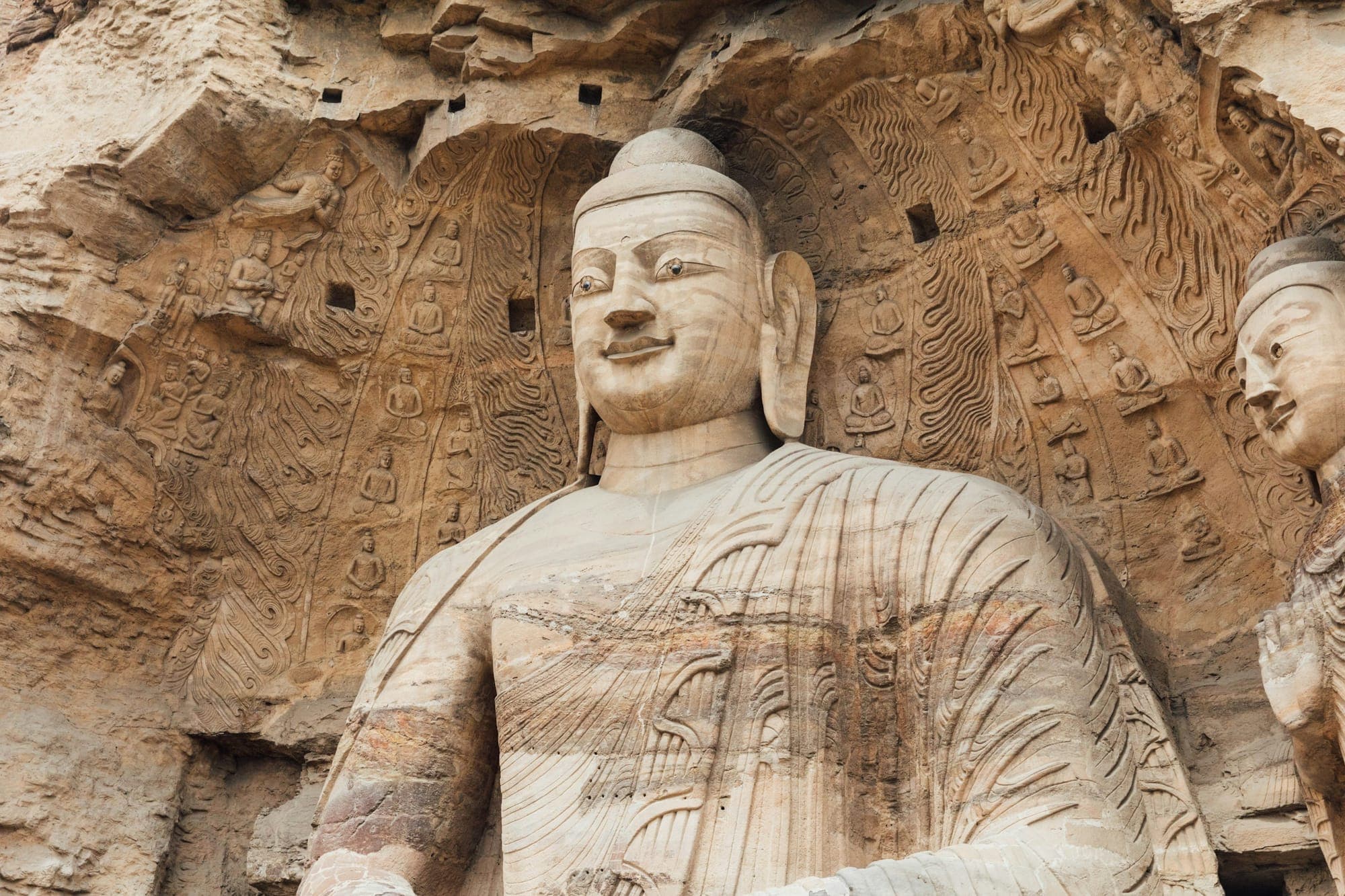
UNESCO inscribed the Longmen Grottoes in 2000 under criteria (i), (ii) and (iii), and describes more than 2,300 caves and niches, almost 110,000 Buddhist stone statues, more than 60 stupas and 2,800 inscriptions carved on steles. The listing treats the whole cliff complex, on both banks of the Yi River, as one property.
UNESCO explains the historical context this way: Luoyang was the capital during the late Northern Wei and early Tang dynasties, and the most intensive carving dates from the end of the 5th century to the mid-8th century. It also identifies two broad styles, the earlier "Central China Style" and the later "Great Tang Style". We suggest looking for both as you walk.
The table below covers the named caves and the two hills that UNESCO mentions, and what the sources confirm about each. We have only listed what the sources say, and we have not ranked the caves.
| Name | Period or detail | What the sources confirm | Hill |
|---|---|---|---|
| Guyangdong | Late 5th and early 6th centuries | One of the earliest caves, containing large Buddha figures | West Hill |
| Three Binyang Caves | Late 5th and early 6th centuries | Among the earliest caves, all containing large Buddha figures | West Hill |
| Yaofangdong Cave | Work continued over a 150-year period | Contains 140 inscriptions recording treatments for various diseases and illnesses | Not specified in the sources cited here |
| Fengxiansi Cave | Tang dynasty, 7th to 8th century | UNESCO says the giant sculptures here are the most fully representative examples of Royal Cave Temples' art | Not specified in the sources cited here |
| East Hill and West Hill overall | Late 5th century to mid-8th century | Caves, statues, steles and inscriptions are scattered across both hills | Both |
A practical reading of the table: the earliest named caves date from the late 5th and early 6th centuries, and the Fengxiansi sculptures from the Tang 7th and 8th centuries. Yaofangdong, with its inscriptions on treatments, is worth a look too.
If you want to see how carved cave temples compare across China, our pages on Dazu Rock Carvings 2026 and Dunhuang Mogao Caves 2026 cover two other sites. Dazu is a separate Chongqing listing from 1999, and Dunhuang is a site of painted cave temples. Each has its own character, so we suggest treating Longmen on its own terms.
Can foreigners visit Longmen without speaking Chinese?
Longmen is listed by UNESCO under its English name, and its key caves are named in pinyin, such as Guyangdong, Yaofangdong and Fengxiansi. We suggest saving those names on your phone to show drivers and hotel staff.
We suggest that foreign visitors can manage a first visit without speaking Mandarin if they prepare a few things in advance.
Our suggestions for language:
- Save the place names in pinyin on your phone. Use "Longmen Grottoes", "Luoyang" and the cave names above. Showing a written name is often easier than pronouncing it.
- Keep your hotel's address ready in written form. Ask the front desk to write your destination and your return point so you can show them if needed.
- Download an offline translation tool before you arrive. A translation app that works without a signal is useful on a long cliff walk where reception may vary.
- Learn the pace, not the language. A few names and a clear plan matter more than conversation. If you know which end of the site you are starting from and which you want to finish at, there is little you need to say.
On payments, mainland China runs heavily on mobile payment. Our page on Alipay for Foreigners explains how to set it up as a visitor. We suggest doing that before you leave home, and keeping a backup payment method with you in case a particular counter or kiosk is awkward.
None of this is a barrier. It is a short checklist, and it is the sort of thing a trip plan should handle for you so that the day itself is about the caves.
Do you need a tour to see the Longmen Grottoes?
You do not need a tour to see the Longmen Grottoes, and LocalKey does not sell group tours. What you need is a plan: a way to get to the site, a sensible order for the two hills and a way to pay and communicate on the day.
LocalKey can arrange that in two forms, and both are your own China trip, planned, booked and backed.
Independent is for visitors who prefer to travel on their own. You use the LocalKey app, and you have 24/7 backup if something goes wrong. Independent has no full-time guide on any day, but a local guide, airport pickup or a private car and driver can be added on demand. For Longmen, we suggest considering a local guide for the half day, since much of the site's meaning is in the stories behind the caves. Details are at Independent.
Private Guided is for visitors who want an English-speaking private guide and a private car throughout the trip. For a cave site like Longmen, where the details are small and the history is long, a guide who can explain the two styles and point out the earliest caves can change how much you take in. Details are at Private Guided.
A short way to choose:
- If you are comfortable with the preparation above and want to go at your own pace, Independent is a good fit, and you can add a local guide for the day.
- If you would rather have explanation and logistics handled throughout, Private Guided is a good fit.
Both options are part of our wider range of private China tours, and neither involves joining a group.
Plan your trip with LocalKey
LocalKey can arrange a visit to the Longmen Grottoes as part of a longer China itinerary, or as the centre of a short stay in Luoyang. Our Luoyang destination page is where we suggest starting if you are still deciding how long to stay. If you are also thinking about other cities with deep heritage, our Xi'an culture page covers a different city on its own terms.
We build each trip around your pace. That might mean a full half day at Longmen with time for both hills, a later start, or a quieter schedule on the day around it. We handle the bookings and the logistics, and we stay reachable if anything changes.
To start, talk to a 1:1 specialist, available 7×24 on WeChat or WhatsApp. Tell us when you plan to travel, how much time you have in Luoyang and whether you prefer Independent or Private Guided, and we will build the plan around it.
Sources
- UNESCO — Longmen Grottoes — verified_on 2026-10-16
- NCHA — Longmen Grottoes — verified_on 2026-08-29 (2026-10-16 recheck timed out)