Yes. Kaiping Diaolou — the towers and villages of Kaiping — are multi-storeyed defensive village houses in Kaiping City, Guangdong. That is the sit. A locked coach that sells a "diaolou tour" as every named tower plus a punch-card photo stop is a different SKU. This page is how an independent traveler sits Kaiping Diaolou — Independent or Private Guided — without buying the tour.
The towers are a World Heritage listing. The UNESCO World Heritage page for Kaiping Diaolou and Villages records the property inscribed in 2007, criteria (ii)(iii)(iv), 371.948 ha plus a 2,738.052 ha buffer, dossier 1112, serial: yes. China's National Cultural Heritage Administration page titles the listing Kaiping Diaolou and Villages; places the heritage in Kaiping City, Guangdong Province; lists the same three criteria; dates the inscription to 2007; and does not publish a hectare figure on that page. UNESCO's brief synthesis names four groups of Diaolou and twenty of the most symbolic inscribed; three forms — communal towers, residential towers, and watch towers — built of stone, pisé, brick or concrete; and a complex fusion of Chinese and Western structural and decorative forms that reflects the role of émigré Kaiping people in South Asia, Australasia and North America in the late 19th and early 20th centuries. NCHA names four heritage clusters — Yinglong Lou in Sanmenli, Chikan Town; the Zili Village cluster and the Fang family lantern tower, Tangkou Town; the Majianglong Village cluster, Baihe Town; and the Jinjiangli Village cluster, Xiangang Town — and writes that Kaiping City holds 1833 towers across 18 towns. You sit one open village group. You do not punch-card twenty towers in one morning, and you do not merge UNESCO's twenty inscribed with NCHA's 1833 city count into one invented number.
The listing is four village groups, not one diaolou punch card
UNESCO keeps Kaiping under one 2007 file. NCHA names the same city as Kaiping City, Guangdong Province. Keep the fabric as one sit when you plan the day. A brochure that stacks every named tower into one timed loop is a group product.
| Sit | Official lock | What you do | What it is not | Source |
|---|---|---|---|---|
| Kaiping Diaolou and Villages | UNESCO: Kaiping; 371.948 ha / 2,738.052 ha buffer; dossier 1112; serial yes; 2007; criteria (ii)(iii)(iv). NCHA: Kaiping City, Guangdong Province; southwest of the Pearl River Delta, next to Hong Kong and Macao | Walk one open village path the site already uses. Sit if a tower or lane is open. Photograph if the site allows it | A tower punch card | UNESCO 1112; NCHA Kaiping Diaolou and Villages |
| Four groups / twenty inscribed | UNESCO: four groups of Diaolou; twenty of the most symbolic inscribed | Keep four groups as the lock if the site opens that stretch. Sit one | A ranked "best twenty" SKU we will not invent | UNESCO 1112 |
| City-wide tower count | NCHA: Kaiping City holds 1833 towers, distributed across the city's 18 towns (and subdistrict offices). UNESCO English brief does not use 1833 | Cite NCHA 1833 as the city count. Do not merge it with UNESCO's twenty | Proof that you "did every tower" | NCHA Kaiping Diaolou and Villages |
| Four NCHA clusters | NCHA: Yinglong Lou in Sanmenli, Chikan Town; the Zili Village cluster and the Fang family lantern tower, Tangkou Town; the Majianglong Village cluster, Baihe Town; and the Jinjiangli Village cluster, Xiangang Town. Captions: Kaiping Diaolou; the Zili Village tower cluster, Tangkou Town; Ruishi Lou, Jinjiangli. UNESCO authenticity names Sanmenli Village | Sit one open cluster if the site opens it. Say Yinglong Lou, Zili Cun, Fangshi Deng Lou, Majianglong, Jinjiangli, or Ruishi Lou if you need a word | Four tickets we will not invent | NCHA Kaiping Diaolou and Villages; UNESCO 1112 |
| Three forms | UNESCO: communal towers (several families, temporary refuge); residential towers (individual rich families, fortified residences); watch towers. Built of stone, pisé, brick or concrete | Read the form of the tower you are standing under. Do not invent a type ranking | A 2026 "which type to book" SKU | UNESCO 1112 |
| Overseas Kaiping | UNESCO: émigré Kaiping people in South Asia, Australasia, North America, late 19th–early 20th centuries. NCHA: 750,000 overseas Chinese and compatriots from Hong Kong, Macao and Taiwan, spread across 67 countries and regions; "two Kaipings, one at home and one abroad" | Sit the fusion as the lock — Chinese and Western forms in one village | A diaspora heritage coach we will not invent | UNESCO 1112; NCHA Kaiping Diaolou and Villages |
We will not invent a 2026 ticket price, an opening-hour table, a bus number, a visitor count, or a ranked "best diaolou." Those change. UNESCO and NCHA keep the criteria, Kaiping City in Guangdong Province, 2007, 371.948 ha / 2,738.052 ha buffer, four groups / twenty inscribed, NCHA 1833 across 18 towns, the four named clusters, three forms, and "two Kaipings, one at home and one abroad." That is the lock.
This page is Kaiping — Kaiping City, Guangdong, as NCHA places it. It is not Guangdong Lingnan culture 2026 and not Fujian tulou 2026. Do not collapse a Kaiping village tower into a Guangzhou Lingnan walk or a Fujian earthen house because a brochure used the word "south China" twice.
How to sit without a diaolou tour
Go toward Kaiping City, Guangdong Province, as NCHA places it: Kaiping City, on the southwest of the Pearl River Delta, next to Hong Kong and Macao on that official line. The official files do not publish a 2026 bus number, gate price, or timed-entry table on those pages, so we will not invent either. Arrive at one village approach. Walk the path the site already uses toward one open stretch — village houses, farmland, then a tower. Sit if a lane or a ground floor is open. Say Kaiping diaolou, or a named fabric — Yinglong Lou, Zili Cun, Fangshi Deng Lou, Majianglong, Jinjiangli, Ruishi Lou — if you need a word. Photograph only if the site allows it. Do not buy a locked departure that sells every named tower as stop one through twelve on a commission morning.
Pay by QR for a ticket if the site uses QR. Set up Alipay for foreigners before you want the day, not at the gate. Cash still appears in smaller rooms. Do not count on English on every path.
Sister sits already live on this site: Guangdong Lingnan culture 2026 for the wider provincial map, not this one Kaiping fabric; Cantonese food experience 2026 for yum cha, not a tower village; Fujian tulou 2026 for earthen communal houses in Nanjing, Hua'an and Yongding, not Guangdong Diaolou; Honghe Hani rice terraces 2026 for a Yunnan four-part terrace landscape, not a Kaiping tower; Jingdezhen porcelain 2026 for a Jiangxi kiln sit, not a village house; China photography trip 2026 is the wider photo map. Keep them apart. UNESCO 1112 is a Kaiping village-tower listing, not a Lingnan city walk, a Fujian tulou, a Honghe terrace, or a Jingdezhen kiln.
What the three forms and the two counts actually lock
UNESCO's English brief is the clean sit. Communal towers were built by several families and used as temporary refuge. Residential towers were built by individual rich families and used as fortified residences. Watch towers are the third form. Stone, pisé, brick or concrete. That is the vocabulary. A brochure that ranks "best type for photos" is a product, not the file.
UNESCO criterion (ii) is the interchange: architectural styles brought back from North America by returning Chinese and fused with local rural traditions. Criterion (iii) is the defensive-tower tradition in the Kaiping area since Ming times, in response to local banditry, and the nominated Diaolou as the final flourishing of that tradition. Criterion (iv) is the main towers, with their settings and through their flamboyant display of wealth, reflecting the role of émigré Kaiping people in South Asia, Australasia and North America in the late 19th and early 20th centuries, and the continuing links between the Kaiping community and Chinese communities in those parts of the world. NCHA's "two Kaipings, one at home and one abroad" is the same overseas lock in Chinese: 750,000 overseas Chinese and compatriots from Hong Kong, Macao and Taiwan, 67 countries and regions. Cite each file as it stands. Do not invent a "returned overseas Chinese trail" SKU.
The two counts stay two counts. UNESCO: four groups; twenty of the most symbolic inscribed; 371.948 ha plus a 2,738.052 ha buffer. NCHA: 1833 towers in 18 towns; four named clusters; no hectare figure on that page. A page that writes "UNESCO 1833" has merged files that the sources do not merge. Since 2001 UNESCO records all the Diaolou as national monuments under the Law for the Protection of Cultural Relics, 1982. A Management Plan drawn up by Beijing University under the People's Government of Kaiping City has been implemented since 2005. That is a protection record. It is not a 2026 ticket.
Can foreigners visit Kaiping Diaolou in 2026 without speaking Chinese?
Yes. Walk one open village path. Sit if a tower or lane is open. Say Kāipíng diāolóu (Kaiping watchtowers) or the place name — Yinglong Lou, Zili Village, Majianglong, Jinjiangli. Point if you need a ticket window. Do not count on English on every path. Pay by QR after you buy what you need.
Do I need a Chinese bank card to pay at Kaiping Diaolou?
No. Pay by QR where the site uses QR. Set up Alipay for foreigners before the day. Cash still appears in some rooms. This page does not invent a 2026 ticket price.
Is Kaiping Diaolou the same as Fujian Tulou or Guangdong Lingnan?
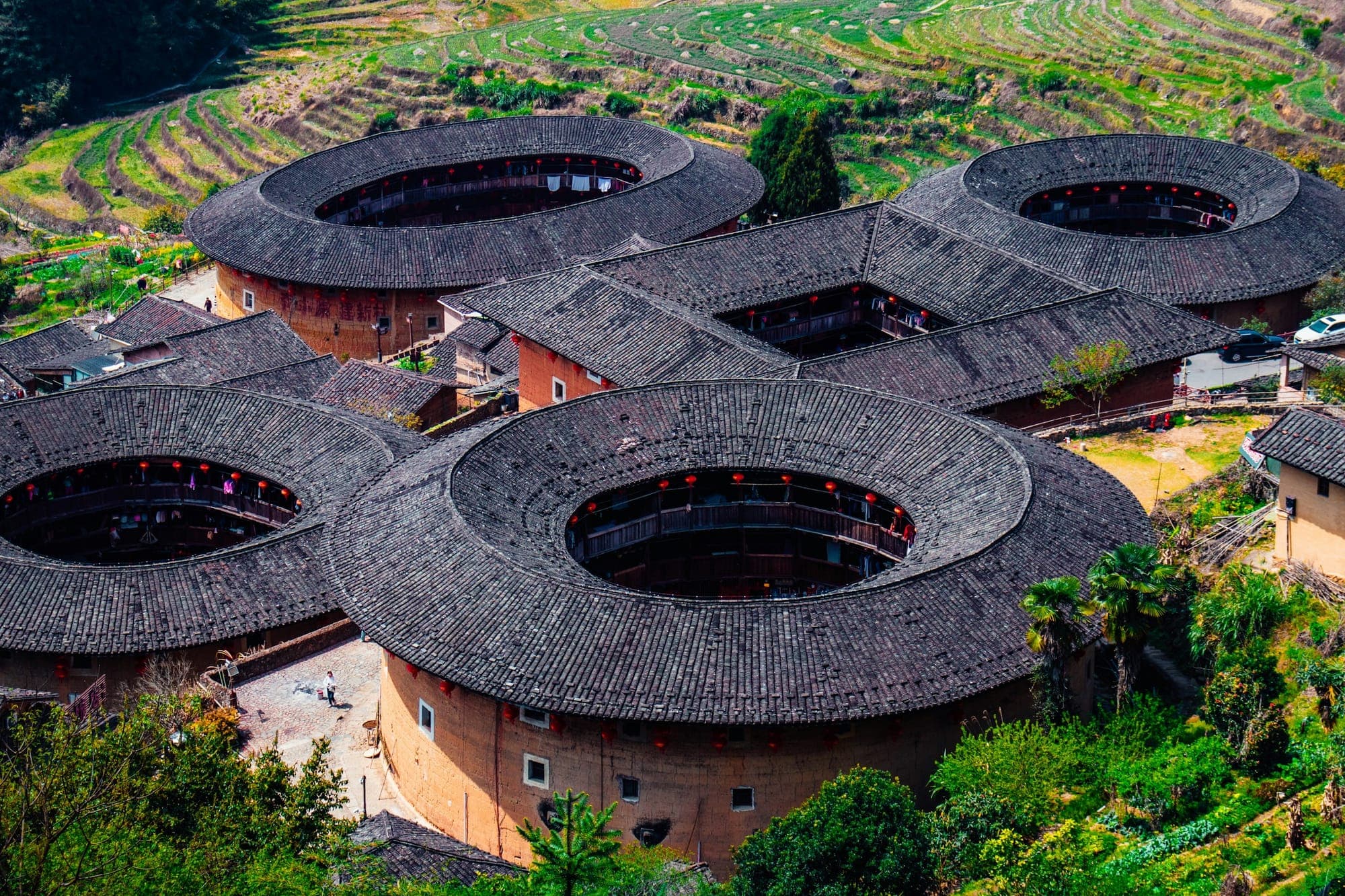
No. Kaiping Diaolou is a village-tower listing in Kaiping City, Guangdong — UNESCO 1112, 2007, criteria (ii)(iii)(iv). Fujian tulou are earthen communal houses in Nanjing, Hua'an and Yongding — UNESCO 1113, 2008. Guangdong Lingnan is the wider provincial culture map, not this one Kaiping fabric. The sister sits are Fujian tulou 2026 and Guangdong Lingnan culture 2026. Do not buy a "south China towers" combo that these files do not make.
Do I need a diaolou tour to see the towers?
No. The sit is one open village group, not stop three on a commission loop. Independent or Private Guided can put one Kaiping day into a Guangdong week you already chose — next to Cantonese food only if you want a second, separate sit, not a combo SKU. A locked Kaiping diaolou departure is a group tour. We do not sell that.
Independent or Private Guided around Kaiping Diaolou
If you want the towers inside a week you already chose — Kaiping as its own day, Lingnan and Fujian tulou kept honest as separate sits, no diāolóu (watchtower) punch-card coach — use Independent Tours or Private Guided. We book the pieces and put a roadbook in the app, with WhatsApp or WeChat support. We do not sell a Kaiping group tour. Contact when you want the week built around one village-tower sit, not a commission coach.