Yes. The Honghe Hani rice terraces — the Cultural Landscape of Honghe Hani Rice Terraces — are a living Hani landscape on the south bank of the Hong River in southern Yunnan. That is the sit. A locked coach that sells a "Yuanyang sunrise tour" as every named viewpoint plus a mushroom-house photo stop is a different SKU. This page is how an independent traveler sits the Honghe Hani rice terraces — Independent or Private Guided — without buying the sunrise tour.
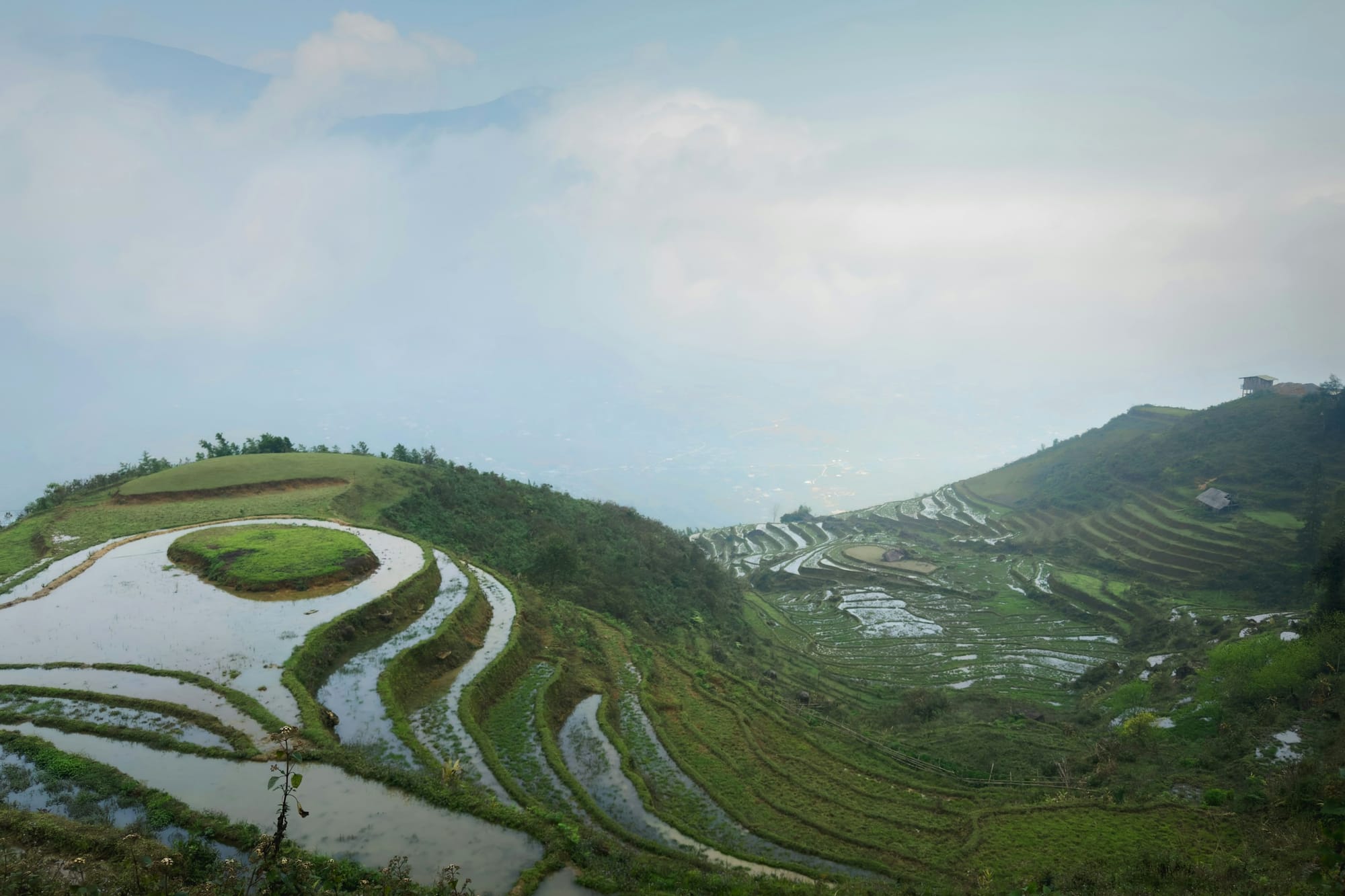
The terraces are a World Heritage listing. The UNESCO World Heritage page for the Cultural Landscape of Honghe Hani Rice Terraces records the property inscribed in 2013, criteria (iii)(v), 16,603.22 ha plus a 29,501.01 ha buffer, dossier 1111, at N23 5 35.8 E102 46 47.93. China's National Cultural Heritage Administration page titles the listing Cultural Landscape of Honghe Hani Rice Terraces; places the heritage in Yuanyang County, Honghe Hani and Yi Autonomous Prefecture, Yunnan Province; lists the same two criteria; dates the inscription to 2013; and places the terraces on the south bank of the Hong River in the Ailao Mountains, area 16,603 ha, stretching across the four counties of Honghe, Yuanyang, Luchun and Jinping. UNESCO's brief synthesis counts 82 villages between the mountaintop forests and the terraces, traditional thatched "mushroom" houses, and a four-fold system of forests, water supply, terraces and houses, cut and farmed over the past 1,300 years. NCHA names the same four-part lock as forests, water systems, terraces and villages — "four elements in one structure", dates the window to over 1,300 years, and writes that the terraces run from the valley floor to above 2,000 m, with as many as 3,700-plus levels. You sit one four-part landscape. You do not punch-card every named sunrise point in one morning.
The listing is one Yuanyang landscape, not one sunrise punch card
UNESCO keeps southern Yunnan under one 2013 file. NCHA names the same county as Yuanyang County, Honghe Hani and Yi Autonomous Prefecture, Yunnan Province. Keep the fabric as one sit when you plan the day. A brochure that stacks every viewpoint into one timed sunrise loop is a group product.
| Sit | Official lock | What you do | What it is not |
|---|---|---|---|
| Honghe Hani Rice Terraces | UNESCO: southern Yunnan; Ailao Mountains to the Hong River; 16,603.22 ha / 29,501.01 ha buffer; dossier 1111; 2013; criteria (iii)(v). NCHA: Yuanyang County, Honghe Hani and Yi Autonomous Prefecture, Yunnan Province; Ailao Mountains, south bank of the Hong River; area 16,603 ha; the four counties of Honghe, Yuanyang, Luchun and Jinping | Walk one open terrace path the site already uses. Sit if a village or terrace edge is open. Photograph if the site allows it | A viewpoint punch card |
| Four-part landscape | UNESCO: forests, water supply, terraces and houses. NCHA: forests, water systems, terraces and villages — "four elements in one structure" | Sit forest, water, terrace and village as one fabric | Four separate tickets we will not invent |
| Terrace counts | UNESCO: in some places as many as 3,000 terraces between forest edge and valley floor. NCHA: from the valley floor up to above 2,000 m; as many as 3,700-plus levels | Cite each file as it stands; do not invent a merged count | Proof that you "did every terrace" |
| Three terrace areas | UNESCO: Bada, Duoyishu and Laohuzui, in three river basins; Bada gentle, Duoyishu steeper, Laohuzui very steep | Keep the three areas as the lock if the site opens that stretch | A ranked sunrise SKU we will not invent |
| Villages and houses | UNESCO: 82 villages, 50–100 households; rammed earth / adobe / earth and stone under a tall thatched roof — distinctive mushroom shape. NCHA: seven long-settled ethnic groups including Hani and Yi; caption Qingkou terraces | Sit one open village if the site opens it. Say mógū fáng (mushroom house) if you need a word | A mushroom-house photo circuit |
| Water and red rice | UNESCO: four trunk canals and 392 branch ditches totalling 445.83 km; red rice with buffalos, cattle, ducks, fish and eel. NCHA: a complex ditch system; water buffalo, ducks, fish; red rice | Watch the water move if a channel is open. Do not invent a farm-stay SKU | A 2026 farm price we will not invent |
Sources for the sit column: UNESCO 1111; NCHA Cultural Landscape of Honghe Hani Rice Terraces.
We will not invent a 2026 ticket price, an opening-hour table, a bus number, a visitor count, or a ranked "best sunrise viewpoint." Those change. UNESCO and NCHA keep the criteria, Yuanyang County, Honghe Hani and Yi Autonomous Prefecture, Yunnan Province, 2013, 16,603.22 ha / 29,501.01 ha buffer, the 3,000 / 3,700-plus count difference across files, 82 villages, "four elements in one structure", Bada / Duoyishu / Laohuzui, and the Qingkou terraces. That is the lock.
This page is Yunnan, Yuanyang as NCHA places it. It is not Jingmai tea forest 2026 and not Lijiang old town 2026. Do not collapse a Honghe terrace landscape into a Pu'er tea forest or a Naxi old town because all three sit in Yunnan on a brochure.
How to sit without a Yuanyang sunrise tour
Go toward Yuanyang County, Honghe Hani and Yi Autonomous Prefecture, Yunnan Province as NCHA places it: Yuanyang County, Honghe, Yunnan, on the south bank of the Hong River in the Ailao Mountains. The official files do not publish a 2026 bus number, gate price, or timed-entry table on those pages, so we will not invent either. Arrive at one terrace approach. Walk the path the site already uses toward one open stretch — forest above, village, then terrace. Sit if a terrace edge or village lane is open. Say Hónghé Hāní Tītián, or a named fabric — sì sù tóng gòu (four elements in one structure), mógū fáng (mushroom house), Qingkou terraces, Duoyishu, Bada, Laohuzui — if you need a word. Photograph only if the site allows it. Do not buy a locked departure that sells every sunrise point as stop one through twelve on a commission morning.
Pay by QR for a ticket if the site uses QR. Set up Alipay for foreigners before you want the day, not at the gate. Cash still appears in smaller rooms. Do not count on English on every path.
Sister sits already live on this site: Yunnan China 2026 for the wider province map, not this one Honghe fabric; Jingmai tea forest 2026 for a Pu'er understorey tea landscape, not a Hong River terrace; Xishuangbanna culture 2026 for a southern Yunnan Dai sit, not Hani terraces; Lijiang old town 2026 for a Naxi town fabric, not Yuanyang; China photography trip 2026 is the wider photo map. Keep them apart. UNESCO 1111 is a Honghe four-part terrace landscape, not a Jingmai tea forest, a Lijiang street, or a Xishuangbanna town.
Can foreigners visit Honghe Hani Rice Terraces in 2026 without speaking Chinese?
Yes. Walk one open terrace path. Sit if a village or terrace edge is open. Say Honghe Hani Titian (Honghe Hani Rice Terraces) or the place name. Point if you need a ticket window. Do not count on English on every path. Pay by QR after you buy what you need.
Do I need a Chinese bank card to pay at Honghe Hani Rice Terraces?
No. Pay by QR where the site uses QR. Set up Alipay for foreigners before the day. Cash still appears in some rooms. This page does not invent a 2026 ticket price.
Is Honghe Hani the same as Jingmai, Lijiang, or Xishuangbanna?
No. Honghe Hani is a terrace landscape in Yuanyang County, Honghe, Yunnan — UNESCO 1111, 2013, criteria (iii)(v). Jingmai is old tea forest in Pu'er. Lijiang is a Naxi old town. Xishuangbanna is a southern Yunnan Dai sit. The sister sits are Jingmai tea forest 2026, Lijiang old town 2026, and Xishuangbanna culture 2026. Do not buy a "Yunnan highlights" combo that these files do not make.
Do I need a Yuanyang sunrise tour to see the terraces?
No. The sit is one open four-part landscape, not stop three on a sunrise commission loop. Independent or Private Guided can put one Yuanyang day into a Yunnan week you already chose — next to Jingmai only if you want a second, separate heritage day, not a combo SKU. A locked Yuanyang sunrise departure is a group tour. We do not sell that.
Independent or Private Guided around Honghe Hani Rice Terraces
If you want the terraces inside a week you already chose — Yuanyang as its own day, Jingmai and Lijiang kept honest as separate sits, no sunrise punch-card coach — use Independent Tours or Private Guided. We book the pieces and put a roadbook in the app, with WhatsApp or WeChat support. We do not sell a Yuanyang group tour. Contact when you want the week built around one four-part sit, not a commission coach.