Yes. The Site of Xanadu (Yuán Shàngdū) is one grassland capital north of the Great Wall, in Zhenglan Banner, Xilingol, Inner Mongolia. That is the sit. A locked coach that sells "Xanadu" as Coleridge plus a ruin punch card is a different SKU. This page is how an independent traveler sits the Site of Xanadu — Independent or Private Guided — without buying the tour.
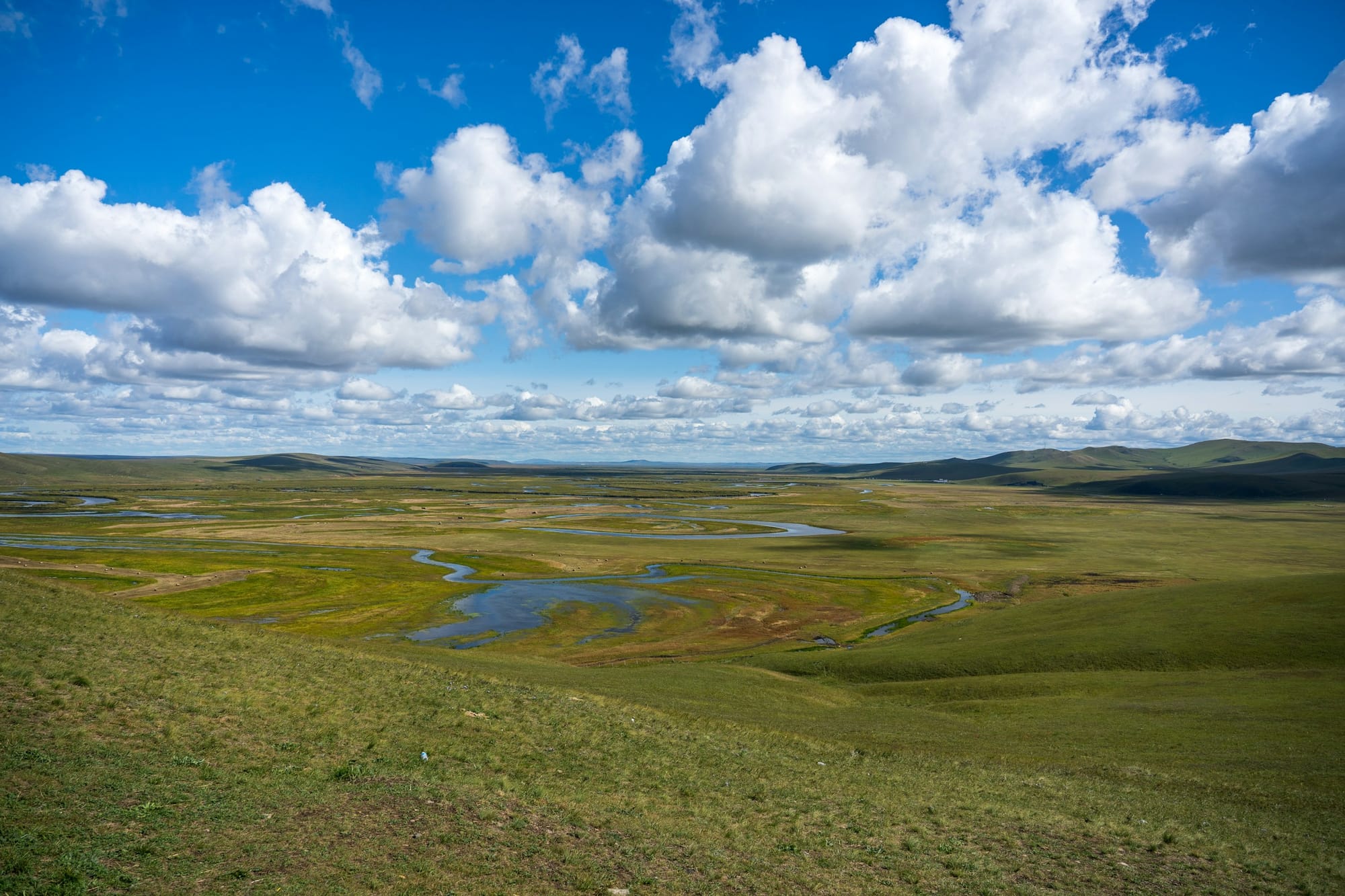
The listing is a World Heritage file. The UNESCO World Heritage page for Site of Xanadu records the property inscribed in 2012, criteria (ii)(iii)(iv)(vi), 25,131.27 ha plus a 150,721.96 ha buffer, dossier 1389. China's National Cultural Heritage Administration page titles the listing Site of Xanadu; places the heritage in Zhenglan Banner, Xilingol League, Inner Mongolia Autonomous Region; lists the same four criteria; dates the inscription to 2012; and publishes an area of about 250 square kilometres — a different area lock from UNESCO's hectare figures, written in that file's units. UNESCO's short description puts the site north of the Great Wall: remains of Kublai Khan's legendary capital, designed by the Mongol ruler's Chinese advisor Liu Bingzhdong — quote the UNESCO spelling — in 1256, over a surface area of 25,000 ha, a unique attempt to assimilate nomadic Mongolian and Han Chinese cultures, with temples, palaces, tombs, nomadic encampments and the Tiefan'gang Canal. NCHA's body places the same site in Zhenglan Banner and Duolun County, backed by Longgang to the north and facing the Luan River to the south, and names the city site (including Palace City, Imperial City and Outer City) plus the outer commercial quarter and the urban flood-control canal. You sit one open fabric. You do not merge UNESCO's 25,131.27 ha with the short description's 25,000 ha or NCHA's about 250 square kilometres into one invented number, and you do not collapse the listing into a poetry morning.
The listing is one grassland capital, not one poetry punch card
UNESCO keeps Xanadu under one 2012 file. NCHA names the same place as Zhenglan Banner, Xilingol League, Inner Mongolia Autonomous Region, and locates the body in Zhenglan Banner and Duolun County. Keep the fabric as one sit when you plan the day. A brochure that stacks a Great Wall selfie plus every named ruin into one timed loop is a group product.
| Sit | Official lock | What you do | What it is not | Source |
|---|---|---|---|---|
| Yuan Shangdu | UNESCO: Site of Xanadu; 2012; criteria (ii)(iii)(iv)(vi); 25,131.27 ha / 150,721.96 ha buffer; dossier 1389. NCHA: Zhenglan Banner, Xilingol League, Inner Mongolia Autonomous Region; about 250 square kilometres | Walk one open path the site already uses. Sit if a named ruin or wall line is open. Photograph if the site allows it | A poetry punch card | UNESCO 1389; NCHA Site of Xanadu |
| Grassland capital | UNESCO OUV: first capital (1263-1273) of Kublai Khan; later summer capital (1274-1364) of the Yuan Dynasty; southeast edge of the Mongolian plateau. NCHA: Yuan Dynasty "summer capital"; the earliest-founded, longest-lasting, most distinctive in layout and best-preserved site | Cite each file as it stands. Sit the open city site | Proof that you "did the Yuan circuit" | UNESCO 1389; NCHA Site of Xanadu |
| Palace / Imperial / Outer City / Palace City, Imperial City, Outer City | UNESCO OUV: Palace and Imperial cities enclosed partly by the Outer City; nomadic encampments and royal hunting enclosure; abandoned 1430. NCHA: the city site (including Palace City, Imperial City and Outer City) as well as the outer commercial quarter and the urban flood-control canal beyond the walls | Sit a named wall line or city if the site opens it | A three-city race we will not invent | UNESCO 1389; NCHA Site of Xanadu |
| Mingde Gate | UNESCO authenticity: repairs to the Mingde Gate and the east wall of the Imperial City; minimal other intervention. NCHA caption: Mingde Gate site | Sit Mingde Gate if the site opens it | A gate-ticket SKU we will not invent | UNESCO 1389; NCHA Site of Xanadu |
| Canal / Tiefan'gang / Tiefan'gan | UNESCO short description: Tiefan'gang Canal. UNESCO OUV: Tiefan'gan Canal. NCHA: urban flood-control canal / flood-control canal remains | Cite each spelling as the file writes it. Sit the canal remains if the site opens them | One invented canal name | UNESCO 1389; NCHA Site of Xanadu |
| Tombs / Oboo | UNESCO: Tombs of Zhenzi Hill; Tombs of Modot; 12 designated Oboo sites; Xar Tala Globeflower plain. NCHA captions: Jinlianchuan grassland and oboo; oboo worship; tomb cluster | Sit a named tomb or oboo if the site opens it | An oboo-circuit coach | UNESCO 1389; NCHA Site of Xanadu |
| 1256 plan / Liu Bingzhdong | UNESCO short description: designed by Liu Bingzhdong in 1256; traditional Chinese feng shui in relation to the nearby mountains and river. NCHA: backed by Longgang to the north, facing the Luan River to the south | Read the lock; do not invent a feng-shui selfie SKU | A commission cosmology coach | UNESCO 1389; NCHA Site of Xanadu |
Sources for the sit column: UNESCO 1389; NCHA Site of Xanadu.
We will not invent a 2026 ticket price, an opening-hour table, a bus number, a visitor count, or a ranked "best ruin." Those change. UNESCO and NCHA keep the criteria, Zhenglan Banner, Xilingol League, Inner Mongolia Autonomous Region, 2012, 25,131.27 ha / 150,721.96 ha buffer vs about 250 square kilometres cited separately, Palace / Imperial / Outer City vs Palace City, Imperial City, Outer City, Mingde Gate, the canal spellings, 1256 / Liu Bingzhdong, and the summer capital lock. That is the lock.
This page is Inner Mongolia — Zhenglan Banner, Xilingol League as NCHA places it, Zhenglan Qi / Xilingol Meng as UNESCO OUV places it. It is not Pingyao Ancient City 2026, not Datong Yungang grottoes 2026, not Mount Wutai 2026, and not Dengfeng Historic Monuments 2026. Keep them apart. Do not collapse a grassland capital file into a Shanxi week or a Beijing day because a brochure used the word "north" twice.
How to sit without a poetry tour
Go toward Zhenglan Banner, Xilingol, Inner Mongolia as NCHA places it: Zhenglan Banner, Xilingol, Inner Mongolia. The official files do not publish a 2026 bus number, gate price, or timed-entry table on those pages, so we will not invent either. Arrive at one grassland approach. Walk one open path the site already uses. Sit one named place — Mingde Gate, Palace City, Imperial City, Outer City, or a named tomb — if the site opens it. Say Yuanshangdu, or a named fabric — Mingde Gate, Muqing Pavilion, Da'an Pavilion, Jinlianchuan, or aobao (stone cairn) — if you need a word. Photograph only if the site allows it. Do not buy a locked departure that sells Coleridge plus every named ruin as stop one through twelve on a commission morning.
Pay by QR for a ticket if the site uses QR. Set up Alipay for foreigners before you want the day, not at the gate. Cash still appears in smaller rooms. Do not count on English on every path.
Sister sits already live on this site: Pingyao Ancient City 2026 for a Shanxi walled city under a different file; Datong Yungang grottoes 2026 for Datong caves; Mount Wutai 2026 for a Xinzhou five-peak Buddhist mountain; Dengfeng Historic Monuments 2026 for a Henan eight-cluster "centre of heaven and earth" landscape; China photography trip 2026 is the wider photo map. Keep them apart. UNESCO 1389 is a Zhenglan grassland capital, not a Pingyao wall, a Yungang cave, a Wutai peak, or a Dengfeng "centre of heaven and earth" day.
What the hectare figures and the summer capital actually lock
UNESCO's short description is one area: 25,000 ha north of the Great Wall, designed in 1256, temples / palaces / tombs / nomadic encampments / Tiefan'gang Canal. UNESCO's sidebar on the same page is a second lock: 25,131.27 ha property and 150,721.96 ha buffer, dossier 1389, N42 21 28.8 E116 11 6.46. UNESCO's Outstanding Universal Value brief synthesis is a third block: grassland capital on the southeast edge of the Mongolian plateau; first capital 1263-1273 then summer capital 1274-1364; Tiefan'gan Canal; abandoned 1430; Palace City, Imperial City and Outer City wall lines still readable under grassland. Cite each block as it stands.
NCHA's lock is place and fabric: heritage distribution Inner Mongolia Autonomous Region, Xilingol League, Zhenglan Banner; body Zhenglan Banner and Duolun County; bordered by Longgang to the north and the Luan River to the south; area about 250 square kilometers; Palace City, Imperial City, Outer City, Guanxiang, urban flood control canal; city walls, gates, roads, moats, flood control canal remains; foundations of palaces, temples, dwellings, warehouses and other buildings, and tombs; Yuan dynasty "summer capital". Captions for Jinlianchuan grassland and aobao, aobao worship, dragon pillar unearthed at Da'an Pavilion, Mingde Gate site, Muqing Pavilion site, aerial view of the Outer City of the Yuanshangdu site. That about 250 square kilometers line is NCHA's. UNESCO's property figure is 25,131.27 ha. Cite each as it stands. Do not convert one into the other.
Criterion (ii) is the integrated Mongolian and Han city plan. Criterion (iii) is exceptional testimony to Kublai Khan's rule and the determination to keep original cultural traditions. Criterion (iv) is the coexistence and fusion of nomadic and farming cultures — a Han city plan with the gardens and landscape necessary to a Mongolian lifestyle. Criterion (vi) is the 13th-century debate between Buddhism and Taoism that the UNESCO file says resulted in dissemination of Tibetan Buddhism over North-east Asia. That is a debate lock on a Zhenglan file. It is not a Tibet itinerary and it is not a Tibetan-plateau page. Protection on the UNESCO file: State / Region / Municipality layers; Zhenglan Qi; Xilingol Meng; Conservation and Management Plan for the Site of Xanadu (2009-2015). That is a protection record. It is not a 2026 ticket. News on the same UNESCO page: 29 June 2012.
Can foreigners visit Yuanshangdu in 2026 without speaking Chinese?
Yes. Walk one open path. Sit one named place if the site opens it. Say Yuanshangdu or a named fabric — Mingde Gate, Palace City, Imperial City, Outer City, Muqing Pavilion, Jinlianchuan, aobao. Point if you need a ticket window. Do not count on English on every path. Pay by QR after you buy what you need.
Do I need a Chinese bank card to pay at Yuanshangdu?
No. Pay by QR where the site uses QR. Set up Alipay for foreigners before the day. Cash still appears in some rooms. This page does not invent a 2026 ticket price.
Is Xanadu the same as Pingyao, Yungang, or a Great Wall day?
No. Yuanshangdu site is a grassland capital in Zhenglan Banner, Xilingol League, Inner Mongolia Autonomous Region — UNESCO 1389, 2012, criteria (ii)(iii)(iv)(vi). Pingyao is a Shanxi walled city under a different file. Yungang is a Datong grotto sit. Wutai is a five-peak Buddhist mountain. UNESCO's short description places this site north of the Great Wall; that is a location lock, not a combo SKU. The sister sits are Pingyao Ancient City 2026 and Datong Yungang grottoes 2026. Do not buy a "north China combo" that these files do not make.
Do I need a poetry tour to see Yuanshangdu?
No. The sit is one open fabric — one named place if the site opens it — not stop three on a Coleridge commission loop. Independent or Private Guided can put one Zhenglan day into a north China week you already chose — next to Yungang only if you want a second, separate sit, not a combo SKU. A locked Xanadu departure is a group tour. We do not sell that.
Independent or Private Guided around Yuanshangdu
If you want the grassland capital inside a week you already chose — Zhenglan as its own day, Yungang or Wutai kept honest as separate sits, no poetry punch-card coach — use Independent Tours or Private Guided. We book the pieces and put a roadbook in the app, with WhatsApp or WeChat support. We do not sell a Xanadu group tour. Contact when you want the week built around one Yuanshangdu sit, not a commission coach.