Yes. The Mountain Resort and its Outlying Temples, Chengde is one Qing summer-palace and temple fabric in Chengde, Hebei. That is the sit. A locked coach that sells a "Chengde tour" as a Beijing day-trip punch card — every hall plus every temple as stop one through twelve — is a different SKU. This page is how an independent traveler sits Chengde Bishu Shanzhuang — Independent or Private Guided — without buying the tour.
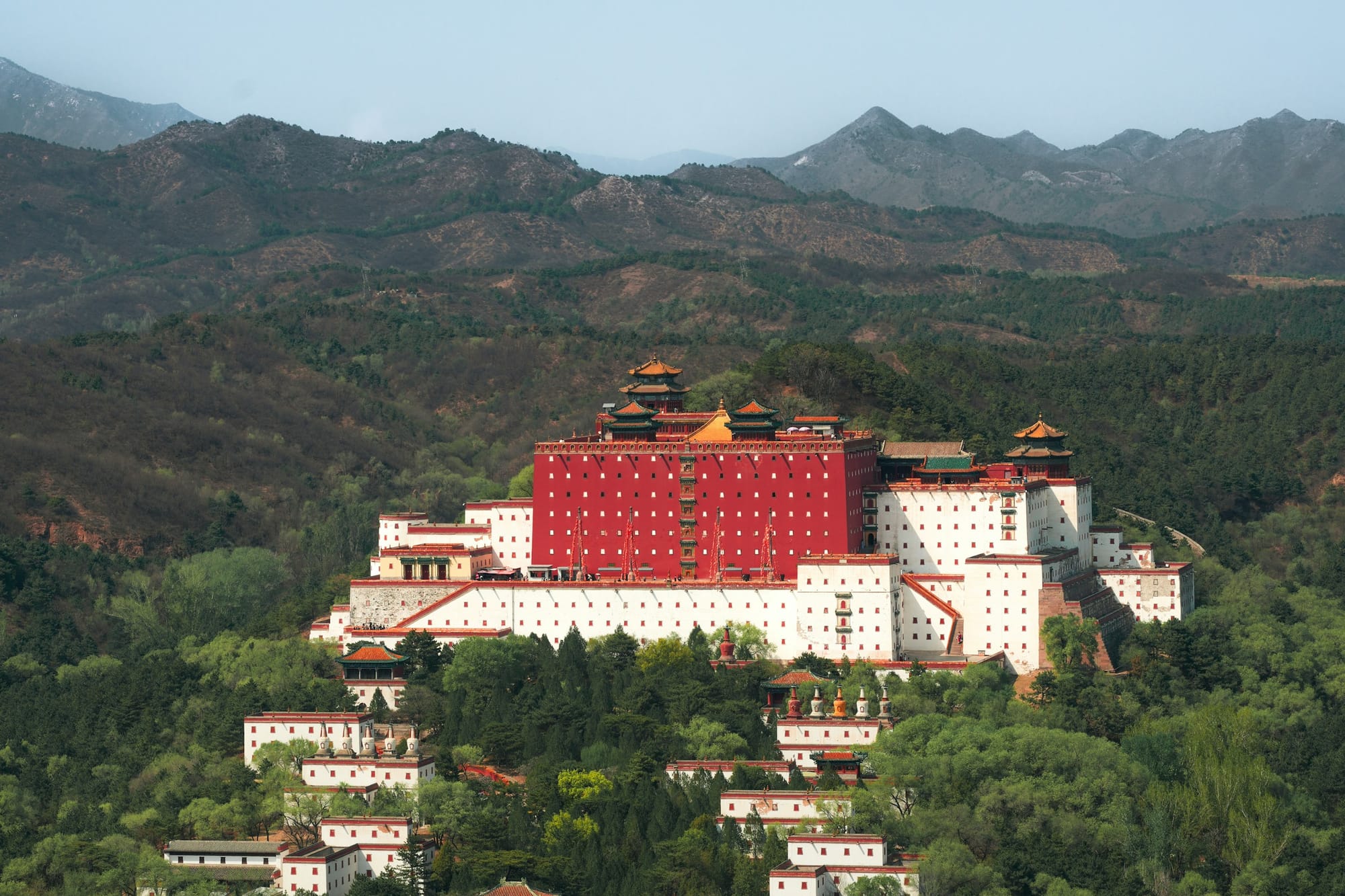
The listing is a World Heritage file. The UNESCO World Heritage page for Mountain Resort and its Outlying Temples, Chengde records the property inscribed in 1994, criteria (ii)(iv), 611.2 ha, dossier 703, in Chengde City, Hebei Province. That sidebar does not publish a buffer-hectare figure. China's National Cultural Heritage Administration page titles the same listing; places the heritage in Chengde City, Hebei; lists the same two criteria; dates the inscription to 1994; and splits area as 564 ha for the Mountain Resort plus 47.2 ha for the temple group. UNESCO's short description puts the Mountain Resort as the Qing dynasty's summer palace in Hebei, built between 1703 and 1792: palaces and administrative and ceremonial buildings, temples of various architectural styles, and imperial gardens blended into lakes, pastureland and forests, plus a rare historic vestige of the final development of feudal society in China. UNESCO's Outstanding Universal Value brief synthesis, cited separately, calls it the largest existing imperial palace-garden and temple complex in China, covering a total area of 611.2 ha, with 12 outlying imperial temples on the eastern and northern hills, built as the Qing emperors' detached summer palace near the imperial Mulan hunting ground 350 kilometres from Beijing. You sit one open fabric. You do not merge UNESCO's 611.2 ha with NCHA's 564 ha and 47.2 ha into one invented fourth number, and you do not punch-card every named hall in one Beijing-day loop.
The listing is one Qing summer palace, not one Chengde punch card
UNESCO keeps Chengde under one 1994 file. NCHA names the same place as Chengde City, Hebei. Keep the fabric as one sit when you plan the day. A brochure that stacks a Beijing coach plus every named palace and temple into one timed loop is a group product.
| Sit | Official lock | What you do | What it is not | Source |
|---|---|---|---|---|
| Mountain Resort and its Outlying Temples, Chengde | UNESCO: Qing summer palace; Hebei; Chengde City; 1994; criteria (ii)(iv); 611.2 ha; dossier 703. NCHA: Chengde City, Hebei | Walk one open path the site already uses. Sit if a palace court, garden water, or outlying temple is open. Photograph if the site allows it | A Chengde punch-card coach | UNESCO 703; NCHA Chengde listing |
| Build dates | UNESCO short: built between 1703 and 1792. NCHA: begun Kangxi 42 (1703), finished Qianlong 57 (1792) | Cite each file as it stands. Sit the open fabric | Proof that you "did all 89 years" | UNESCO 703; NCHA Chengde listing |
| Area lock | UNESCO sidebar, OUV, and Integrity: 611.2 ha property. NCHA: 564 ha Mountain Resort; 12 temples 47.2 ha; building area more than 60,000 square meters | Cite 611.2, 564, 47.2, and 60,000 separately. Do not invent a buffer-hectare figure UNESCO omitted | A hectare-collection SKU | UNESCO 703; NCHA Chengde listing |
| Palace area and garden area | UNESCO short: palaces and administrative and ceremonial buildings; imperial gardens; lakes, pastureland and forests. NCHA: palace area and garden-scenic area | Sit one open court or water if the site opens it | A palace-circuit coach | UNESCO 703; NCHA Chengde listing |
| 12 outlying imperial temples | UNESCO OUV: 12 outlying imperial temples, some in the architectural styles of the ethnic minorities, eastern and northern hills. NCHA: 12 imperial temple groups, 47.2 ha | Sit one open temple if the site opens it. Quote "12" as each file writes it | A twelve-temple race we will not invent | UNESCO 703; NCHA Chengde listing |
| Kangxi / Qianlong / Mulan | UNESCO OUV: every summer and autumn, emperors including Kangxi and Qianlong handled military and government affairs here, received ethnic-minority leaders and foreign envoys, and went north to hold the Mulan Autumn Hunting. Mulan hunting ground 350 kilometres from Beijing | Read the lock. Sit the Chengde fabric. Do not invent a Mulan add-on SKU | A hunting-combo coach | UNESCO 703 |
Sources for the sit column: UNESCO 703; NCHA Chengde listing.
We will not invent a 2026 ticket price, an opening-hour table, a bus number, a visitor count, a ranked "best temple," or a buffer-hectare figure. Those change, or the files omit them. UNESCO and NCHA keep the criteria, Chengde City, Hebei, 1994, dossier 703, the four area locks cited separately, 1703–1792, 12 outlying imperial temples, Kangxi and Qianlong, and the Qing summer-palace lock. That is the lock.
This page is Hebei — Chengde City as NCHA places it, Chengde City, Hebei Province as UNESCO's sidebar places it. It is not Suzhou Classical Gardens 2026, not Mount Wudang Ancient Buildings 2026, not Pingyao Ancient City 2026, and not Beijing Hutong Walk 2026. Keep them apart. Do not collapse a Chengde Qing summer palace into a Suzhou garden day, a Danjiangkou Taoist mountain, a Shanxi walled city, or a Beijing hutong walk because a brochure used the word "imperial" twice.
How to sit without a Chengde tour
Go toward Chengde City, Hebei as NCHA places it. The official files do not publish a 2026 bus number, gate price, or timed-entry table on those pages, so we will not invent either. Arrive at one mountain-resort approach. Walk one open path the site already uses. Sit a palace court, a garden water, or one of the 12 outlying temples if the site opens it. Say Chengde, Bishu Shanzhuang, Mountain Resort, or Outlying Temples if you need a word. Photograph only if the site allows it. Do not buy a locked departure that sells a Beijing day-trip plus every named hall as stop one through twelve on a commission morning.
Pay by QR for a ticket if the site uses QR. Set up Alipay for foreigners before you want the day, not at the gate. Cash still appears in smaller rooms. Do not count on English on every path.
Sister sits already live on this site: Suzhou Classical Gardens 2026 for a Jiangsu garden file; Mount Wudang Ancient Buildings 2026 for a 1994 Hubei Taoist mountain under a different file; Pingyao Ancient City 2026 for a Shanxi walled city; Beijing Hutong Walk 2026 for a Beijing lane sit; China photography trip 2026 is the wider photo map. Keep them apart. UNESCO 703 is a Chengde Qing palace-garden and temple fabric, not a Suzhou garden, a Wudang hall, a Pingyao wall, or a Beijing hutong.
What the hectare figures and the 12 temples actually lock
UNESCO's short description is one block: Qing dynasty summer palace in Hebei; built 1703 to 1792; palaces and administrative and ceremonial buildings; temples of various architectural styles; imperial gardens; lakes, pastureland and forests; rare historic vestige of the final development of feudal society in China. It does not publish 611.2 ha. Cite it as that block.
UNESCO's Outstanding Universal Value brief synthesis is a second block on the same page: largest existing imperial palace-garden and temple complex in China; total area 611.2 ha; built 1703–1792 as the Qing emperors' detached summer palace near the imperial Mulan hunting ground 350 kilometres from Beijing; 12 outlying imperial temples, some in ethnic-minority architectural styles, eastern and northern hills; Kangxi and Qianlong handled military and government affairs here; Mulan Autumn Hunting; Han, Mongolian and Tibetan architectural art in the temples; danxia landform; fengshui; influence in Europe and a role in 18th-century landscape garden design worldwide. Cite that block as it stands. A page that writes "UNESCO 564 ha" as if the short description said that number has merged files the source keeps apart.
UNESCO Integrity is a third lock: within the 611.2 ha area covered by the property, the historic layout and natural system of hills and water since the 18th century are basically integrally preserved; Han, Manchu, Mongolian and Tibetan cultures; integration of Confucianism, Buddhism, Taoism and other religions. That 611.2 ha is Integrity's and the sidebar's. Do not convert it into NCHA's 564.
NCHA's lock is place and fabric: Chengde City, Hebei; begun Kangxi 42 (1703), finished Qianlong 57 (1792); largest existing imperial palace-garden and royal temple complex in China; Mountain Resort 564 ha, palace area and garden-scenic area; 12 imperial temple groups on the eastern and northern foothills, 47.2 ha, building area more than 60,000 square meters; Han, Mongolian and Tibetan architectural forms; fengshui; influence on Europe; 18th-century landscape design. That 564 ha and 47.2 ha are NCHA's. UNESCO's property figure is 611.2 ha. Cite each as it stands. Do not invent a buffer-hectare figure either file omitted on these pages.
Criterion (ii) is an outstanding example of Chinese integration of buildings into the natural environment, with a profound influence on landscape design. Criterion (iv) is the Mountain Resort and its Outlying Temples as material form of the final flowering of feudal society in China. Protection on the UNESCO file: Law of the People’s Republic of China on the Protection of Cultural Relics; State Priority Protected Site; Regulations on the Protection of Chengde Mountain Resort and its Outlying Temples (People’s Standing Committee of Hebei Province); Conservation Plan for the Historically and Culturally Famous City of Chengde; Conservation Master Plan submitted for approval. That is a protection record. It is not a 2026 ticket.
Can foreigners visit Chengde Mountain Resort in 2026 without speaking Chinese?
Yes. Walk one open path. Sit a palace court, a garden water, or one of the 12 outlying temples if the site opens it. Say Chengde, Bishu Shanzhuang, Mountain Resort, or Outlying Temples. Point if you need a ticket window. Do not count on English on every path. Pay by QR after you buy what you need.
Do I need a Chinese bank card to pay at Chengde Mountain Resort?
No. Pay by QR where the site uses QR. Set up Alipay for foreigners before the day. Cash still appears in some rooms. This page does not invent a 2026 ticket price.
Is Chengde the same as Suzhou gardens, Wudang, or a Beijing hutong day?
No. Chengde Mountain Resort is a Qing palace-garden and temple fabric in Chengde City, Hebei — UNESCO 703, 1994, criteria (ii)(iv). Suzhou gardens are a Jiangsu garden file. Wudang is a Danjiangkou Taoist mountain under a 1994 file that is not this one. A Beijing hutong is a lane sit, not this listing. The sister sits are Suzhou Classical Gardens 2026 and Mount Wudang Ancient Buildings 2026. Do not buy an "imperial combo" that these files do not make.
Do I need a Chengde tour to see the Mountain Resort?
No. The sit is one open fabric — one named place if the site opens it — not stop three on a Beijing-day commission loop. Independent or Private Guided can put one Chengde day into a Hebei week you already chose. A locked Chengde departure is a group tour. We do not sell that.
Independent or Private Guided around Chengde Mountain Resort
If you want the Qing summer-palace fabric inside a week you already chose — Chengde as its own day, Suzhou gardens or Wudang kept honest as separate sits, no Beijing punch-card coach — use Independent Tours or Private Guided. We book the pieces and put a roadbook in the app, with WhatsApp or WeChat support. We do not sell a Chengde group tour. Contact when you want the week built around one Chengde Mountain Resort sit, not a commission coach.