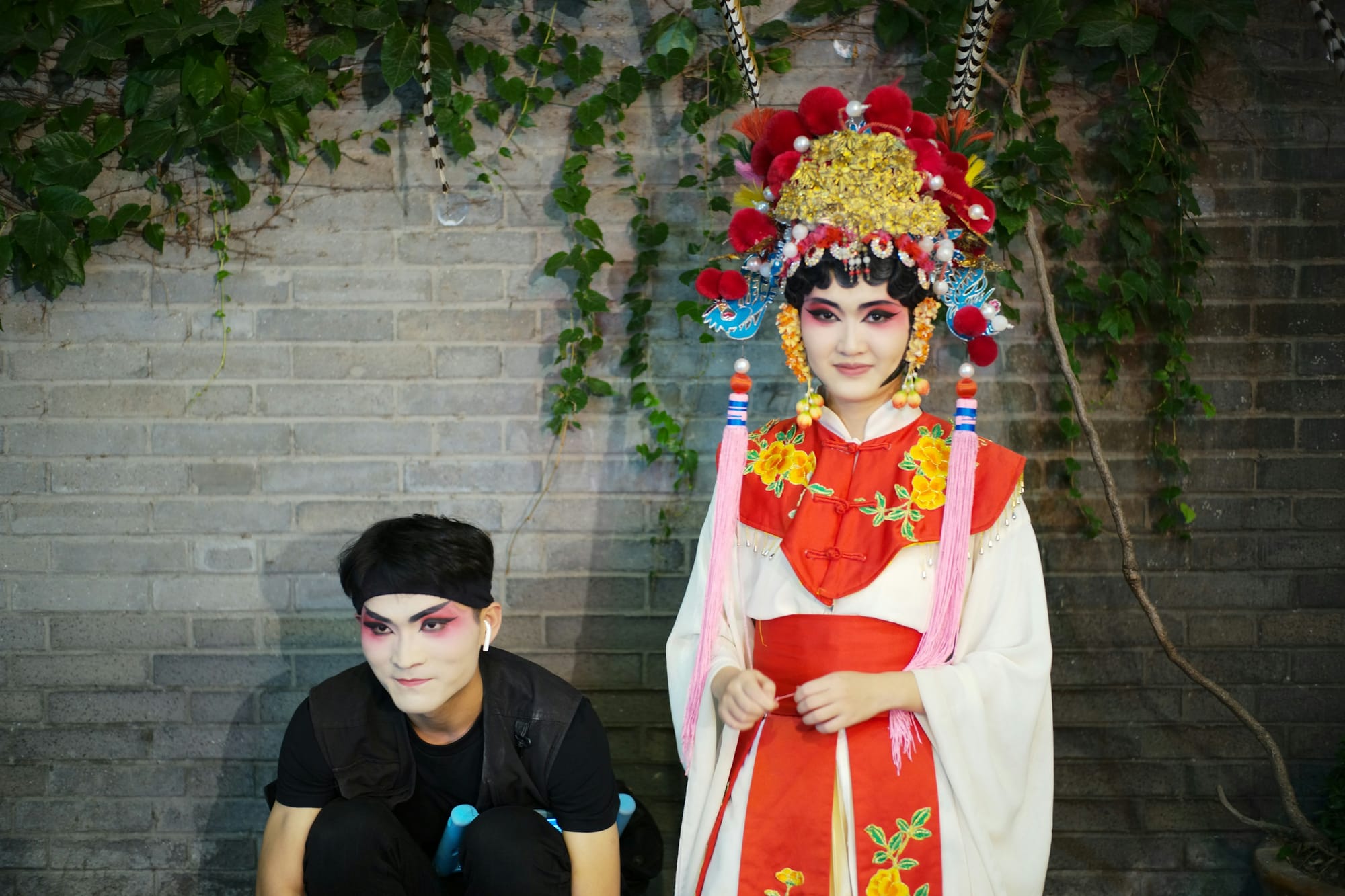
Yes. Sichuan Opera is a seated theatre performance in Chengdu: five vocal systems, painted faces, bian lian (face-changing) as a stunt inside the play. That is the craft. A tour van that sells "Chinese opera" as a costume photo and a hard sell is a completely different experience.
This page is how an independent traveler spends an evening at the opera in Chengdu in 2026 — Independent or Private Guided — without buying a group opera tour. You pick one posted bill from a working company. You buy one ticket. You take your seat. Face-changing is a trick inside the opera, not a separate tour product and not a reason to board an evening-show coach. LocalKey does not sell group opera tours.
The stage is a national craft, not a show-tour stop
The performance people actually watch is one posted play. The Ministry of Culture and Tourism's China Intangible Cultural Heritage (ICH) Digital Museum listing records the form as national item 156, number IV-12, first batch, 2006, under traditional drama. The same page places the living map across Sichuan, Chongqing, and parts of Yunnan, Guizhou, and Hubei, and calls it the largest local opera form in southwest China. A Ministry of Culture and Tourism first-batch gazette (Guofa 2006 No. 18, dated 20 May 2006) lists serial 156, number IV-12, with Sichuan Province and Chongqing Municipality as the declaring regions. That is the official heritage record, not a theatre ranking.
The official craft page is specific. Five vocal systems share one stage: gaoqiang, huqin, tanxi, kunqu, and dengdiao. They did not arrive as a tourist set. Kunqu, Yiyang, Qingyang, Shaanxi bangzi, Hubei han diao, and Hui diao moved into Sichuan from the late Ming into the early Qing; by the Qianlong and Jiaqing years they had mixed with local work songs, river chants, small tunes, and religious music. Around 1911 Revolution the five systems fused in shared performance — five-tune sharing — and that is the form that still posts bills. The same listing names more than six thousand traditional and new plays, five role types (xiaosheng, dan, sheng, hualian, chou), and stage stunts built to serve character, not a photo queue: bian lian (face-changing), hiding a knife, the fire hoop, opening the wisdom eye. Gaoqiang is the most distinctive of the five systems: bang (choral assist), percussion, and singing joined together. Prices and performance schedules vary by theatre, so check the official box office before you go.
Sichuan's own legislature treats the same craft as living law, not a shopping-mall tourist product. A Sichuan People's Congress Standing Committee press conference in Chengdu released the Sichuan Opera Protection and Inheritance Ordinance as a new provincial regulation. Sichuan and Chongqing passed companion ordinances together; both took effect on 1 September 2024. The Congress note calls that the first inter-provincial substantive collaborative legislation in the culture field in the country. The frame is salvage protection, talent, play production, company building, research, and popularization — including the hard fact that some grassroots companies were close to disappearing. That is a legal duty to protect the heritage, not a ticket service.
The provincial academy keeps a documentation room, not a box office. The Sichuan Provincial Academy of Art page on the Sichuan opera art communication digital museum records a joint project with the School of Communication Science and Art at Chengdu University of Technology: the first national digital museum built to protect, inherit, and spread the national ICH form. Digitized exhibits in the thousands, VR scenes, interactive hotspots. You can explore the craft there, but you attend an evening performance in a working theatre, not in a VR booth sold as a show tour.
You go to watch an evening performance under the stage lights. You do not need a coach that sells "Sichuan opera" as stop four on a panda-and-hotpot loop.
Five vocal systems, one stage
Official sources distinguish one form with five living vocal systems. Travellers can see these performed across different Chengdu theatres.
| Feature | What it is | What to do | Tips |
|---|---|---|---|
| Chuanju craft | Listed as national intangible cultural heritage in 2006 (first batch, serial 156, number IV-12), with Sichuan and Chongqing as declaring regions | Watch one posted evening | Book a standard theatre ticket rather than a package tour |
| Five vocal systems | Gaoqiang, huqin, tanxi, kunqu, dengdiao; five-tune sharing on the ICH page | Ask which system you are looking at | Each performance typically highlights specific vocal traditions |
| Bian lian / face-changing | Named on the ICH page as a stunt inside the play, with hiding a knife, the fire hoop, opening the wisdom eye | Watch the change if that evening's play includes it | Face-changing is part of the drama, not a standalone show |
| Chengdu / Sichuan companies | Provincial ordinance 2024 + Academy digital museum | One theatre, one night. | Choose an active local theatre rather than a shopping tour |
Sources for this table: China ICH Digital Museum IV-12; Ministry of Culture and Tourism first-batch gazette; Sichuan People's Congress ordinance briefing; Sichuan Provincial Academy of Art digital museum.
Bian lian is the stunt visitors type into a search box. The ICH page keeps it inside the opera, next to other stage tricks used to build a character. A brochure that sells "face-changing" as its own evening, stripped of gaoqiang and the play, is a completely different product. Go for the play. If the bill that night uses the change, you will see it. If it does not, you still experienced chuanju.
Several working theatres across Chengdu stage regular performances. Check the current schedule at a local venue and buy a ticket directly.
How to see a show without a show tour
Buy a single evening or matinee from a working company board that already posts the bill. Walk in and take your seat. Say chuanju, or Sichuan opera, or name one play if you already chose it. Photograph the stage only if the house allows it. Do not stand in the aisle for a costume selfie during the aria. Do not treat bian lian as a pose you paid extra to join.
Seat prices and showtimes vary by theatre, so confirm them on the day's board. Do not count on English on the wall.
Pay by QR if the box office takes it. Set up Alipay for foreigners before you want a ticket, not at the door. Cash still appears at some older windows.
This is not a teahouse morning. For that experience, see our guide to the Chengdu teahouse. A needle under a lamp is a different craft, on Chengdu Shu embroidery. Beijing's own music theatre is a different company system, on Beijing opera 2026. Suzhou's older Jiangnan form is covered in Suzhou Kunqu 2026. Do not paste a panda park, a hotpot mall, and a silk stop onto one chuanju evening because a brochure used the word culture twice.
A weir day and a Taoist mountain day are separate Sichuan day trips: Dujiangyan Irrigation 2026 and Chengdu Qingcheng Taoist 2026. The opera evening does not need those tickets stacked on the same night.
Is Sichuan opera the same as a Chengdu show tour?
No. Sichuan opera is a seated theatre performance: one posted play, five vocal systems, painted faces, bian lian as a stunt inside the bill if that night uses it. A show tour is a tour coach with a lecture at every stop and a hard sell after the change. The national ICH record lists a traditional-drama technique, not a packaged tour. Pick a theatre and enjoy the performance.
How do foreigners see Sichuan opera in Chengdu without speaking Chinese?
Pick a scheduled evening. Buy a ticket. Take your seat. Say chuanju or Sichuan opera. Point at the bill if the window has no English. Confirm the day's price on the board before you pay. Pay by QR. Set up Alipay for foreigners before you want a ticket. Independent or Private Guided can put the theatre in a Chengdu night you already chose. LocalKey does not sell an opera van.
Do I need a Chengdu culture tour to see face-changing?
No. Face-changing is bian lian, a stunt inside the opera. It is not a separate evening and not stop four on a walking tour that earns commission. Pick a theatre with a posted schedule and take your seat. If that bill uses the change, you will see it. A fixed group departure is a group tour. We do not sell that.
Is Sichuan opera a theatre ranking or an official craft?
It is a technique and a living repertoire, not a brand list. The China ICH Digital Museum listing and the Ministry of Culture and Tourism first-batch gazette keep national number IV-12 with Sichuan and Chongqing as declaring regions. Sichuan's People's Congress briefing keeps a 2024 protection ordinance. The provincial academy keeps a digital museum for the same craft. Visitors can attend a performance at any working theatre in the city.
Is Sichuan opera the same as Beijing opera or Kunqu?
No. Chuanju is its own southwest form: five vocal systems on one stage, with bian lian as a stunt inside some plays. Beijing opera is a different company system with Beijing as a centre — see Beijing opera 2026. Kunqu is older Jiangnan music theatre; see our guide on Suzhou Kunqu 2026. They are distinct traditions from different cities. One of chuanju's five vocal systems borrowed the name kunqu after the older form moved west. That does not turn a Chengdu evening into a Suzhou performance.
Can foreigners see Sichuan opera in 2026 without speaking Chinese?
Yes. Walk in, buy a ticket from the posted schedule, and take your seat. Say chuanju or point to the bill. Do not count on English on the wall. You can buy tickets directly at the theatre box office.
Do I need a Chinese bank card to pay for a ticket?
No. Pay by QR if the box office takes it. Set up Alipay for foreigners before you want the window, not after the drums start. Cash still appears at some older rooms. Check the box office window for the day's ticket prices.
How this fits in an Independent or Private Guided week
The stage does not need its own coach day. It can fit inside a Chengdu week you already chose — an evening after a teahouse morning on Chengdu teahouse, or a night after a quiet stitch on Chengdu Shu embroidery. Keep this as one evening, not a third attraction stacked between a panda ticket and a silk shop.
If you already have a weir day or a Taoist mountain day on the same trip, keep them on different days. The weir is a living irrigation site, on Dujiangyan Irrigation 2026. The mountain is a temple path, on Chengdu Qingcheng Taoist 2026. The opera is a posted bill. Do not buy a combo that treats all three as one timed loop.
This is the opposite of a group opera tour: no fixed departure, no lecture at every change. To compare group travel with private itineraries, read China group tours or a custom trip and plan an evening performance on your own terms.
If you want the night booked, not a show tour
LocalKey books customized independent travel. We do not sell group tours. We do not sell a Chengdu evening-show coach. We do not run opera tours. We do not sell face-changing as a separate tour product.
Two ways to travel, both private. Independent: hotels, trains, the LocalKey app and 24/7 WhatsApp or WeChat backup; add a car and driver or a local guide on the days you want one. Private Guided: the same planning, with private guides, a driver and a car across the trip. A seat for one posted play is the culture. A walking show tour is not what we do.
LocalKey Travel is the visitor brand of Guangdong Xingcheng International Travel Agency (est. 2009).
Official sources
- China ICH Digital Museum — national listing IV-12 — verified_on 2026-10-25
- Ministry of Culture and Tourism — first-batch national ICH gazette (Guofa 2006 No. 18) — verified_on 2026-10-25
- Sichuan People's Congress — ordinance press conference — verified_on 2026-10-25
- Sichuan Provincial Academy of Art — Sichuan opera art communication digital museum — verified_on 2026-10-25