Updated 7 October 2026 · LocalKey consultant team
For a first trip to China, we suggest Beijing, Xi'an and Shanghai with Suzhou or Hangzhou, a route built on UNESCO World Heritage sites inscribed in 1987 and later. Add Guilin and Yangshuo or Zhangjiajie for karst and sandstone scenery, Chengdu (a UNESCO City of Gastronomy since 2010) for food, and Dunhuang for the Silk Road.
Where should you go in China on a first trip?
For a first trip, we suggest Beijing, Xi'an and Shanghai, adding Suzhou or Hangzhou; Beijing's Imperial Palaces and Xi'an's Mausoleum of the First Qin Emperor were both inscribed on the UNESCO World Heritage List in 1987. According to UNESCO (retrieved 7 October 2026), China has 61 World Heritage properties: 42 cultural, 15 natural and 4 mixed.
The table below covers every trip type in this article; the sections after it go deeper.
| Place | Trip type | UNESCO anchor (year) | Inside 240-hour areas? | Read next |
|---|---|---|---|---|
| Beijing | First trip, imperial history | Imperial Palaces (1987), The Great Wall (1987), Beijing Central Axis (2024) | Yes | Beijing city page |
| Xi'an | First trip, ancient dynastic capitals | Mausoleum of the First Qin Emperor (1987) | Yes | Xi'an city page |
| Shanghai | First trip, modern skylines | — | Yes | Shanghai city page |
| Suzhou | Classical gardens | Classical Gardens of Suzhou (1997, 2000) | Yes | Suzhou city page |
| Hangzhou | West Lake cultural landscape | West Lake Cultural Landscape of Hangzhou (2011) | Yes | Hangzhou city page |
| Guilin and Yangshuo | Karst scenery, river days | South China Karst (2014) | Guilin: Yes (named city); Yangshuo: not named on the NIA list | Guilin city page |
| Zhangjiajie | Sandstone pillars many over 200 m | Wulingyuan Scenic and Historic Interest Area (1992) | Yes | Zhangjiajie city page |
| Huangshan | Mountain walks | Mount Huangshan (1990) | Yes | Huangshan city page |
| Jiuzhaigou | Waterfalls and valley scenery | Jiuzhaigou Valley Scenic and Historic Interest Area (1992) | Yes | Jiuzhaigou city page |
| Chengdu with Leshan and Emei | City of Gastronomy, giant pandas | Mt Emei and Leshan Giant Buddha (1996), Panda Sanctuaries (2006) | Yes | Chengdu city page |
| Lijiang and Dali | Historic towns | Old Town of Lijiang (1997) | Yes | Lijiang city page |
| Pingyao | 14th-century banking city | Ancient City of Ping Yao (1997) | No | Pingyao city page |
| Dunhuang | Silk Road art | Mogao Caves (1987) | No | Dunhuang city page |
| Hong Kong SAR and Macau SAR | City of Gastronomy, coastal travel | Historic Centre of Macao (2005) | Separate entry system | Hong Kong and Macau city pages |
Under the National Immigration Administration (NIA) policy (page dated 20 August 2026), nationals of 57 countries who fly on to a third country or region may stay up to 10 days without a visa within 24 permitted provincial-level areas (areas per the NIA notice of 17 December 2024). Those areas include Beijing, Shanghai, Shaanxi, Jiangsu, Zhejiang, Hunan, Sichuan and 12 named cities in Guangxi including Guilin; Gansu, Xinjiang and Tibet are outside, and in Shanxi only Taiyuan and Datong are covered. You can review boundary limits and border checkpoints in our 240-hour visa-free transit guide.
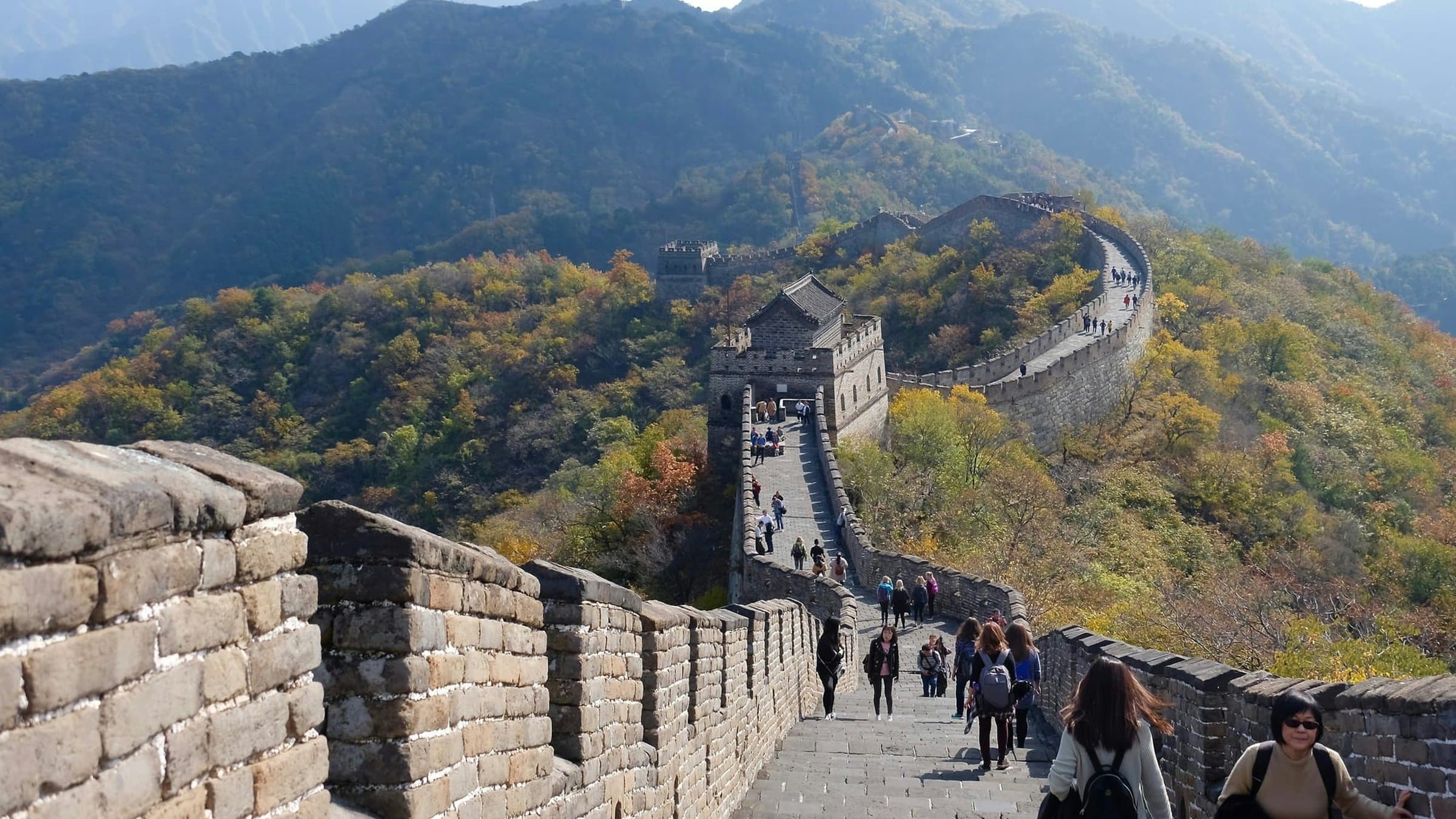
When structuring your first journey, we usually suggest pairing Beijing, Xi'an, and Shanghai. In Beijing, the urban fabric combines the vast courtyards of the Forbidden City, the 1998-inscribed Temple of Heaven and Summer Palace, and the Beijing Central Axis inscribed in 2024, alongside excursions to the Great Wall. In Xi'an, the Terracotta Army at the Mausoleum of the First Qin Emperor is the main sight.
From there, we usually pair Shanghai with Suzhou for the Classical Gardens of Suzhou or Hangzhou for the lakeside scenery of West Lake. Our sample routes run 5 to 10 days (which you can inspect across our curated itineraries or our dedicated 10-day China itinerary route), providing a balanced introduction to the country.
Where should you go in China for karst, mountains and nature?
For natural landscapes and geology, we suggest the South China Karst inscribed in 2007 and extended in 2014, the sandstone towers of the Wulingyuan Scenic and Historic Interest Area inscribed in 1992, and the mixed cultural and natural landscape of Mount Huangshan inscribed in 1990. We suggest these areas for travellers who want walking days; see our hiking experiences.
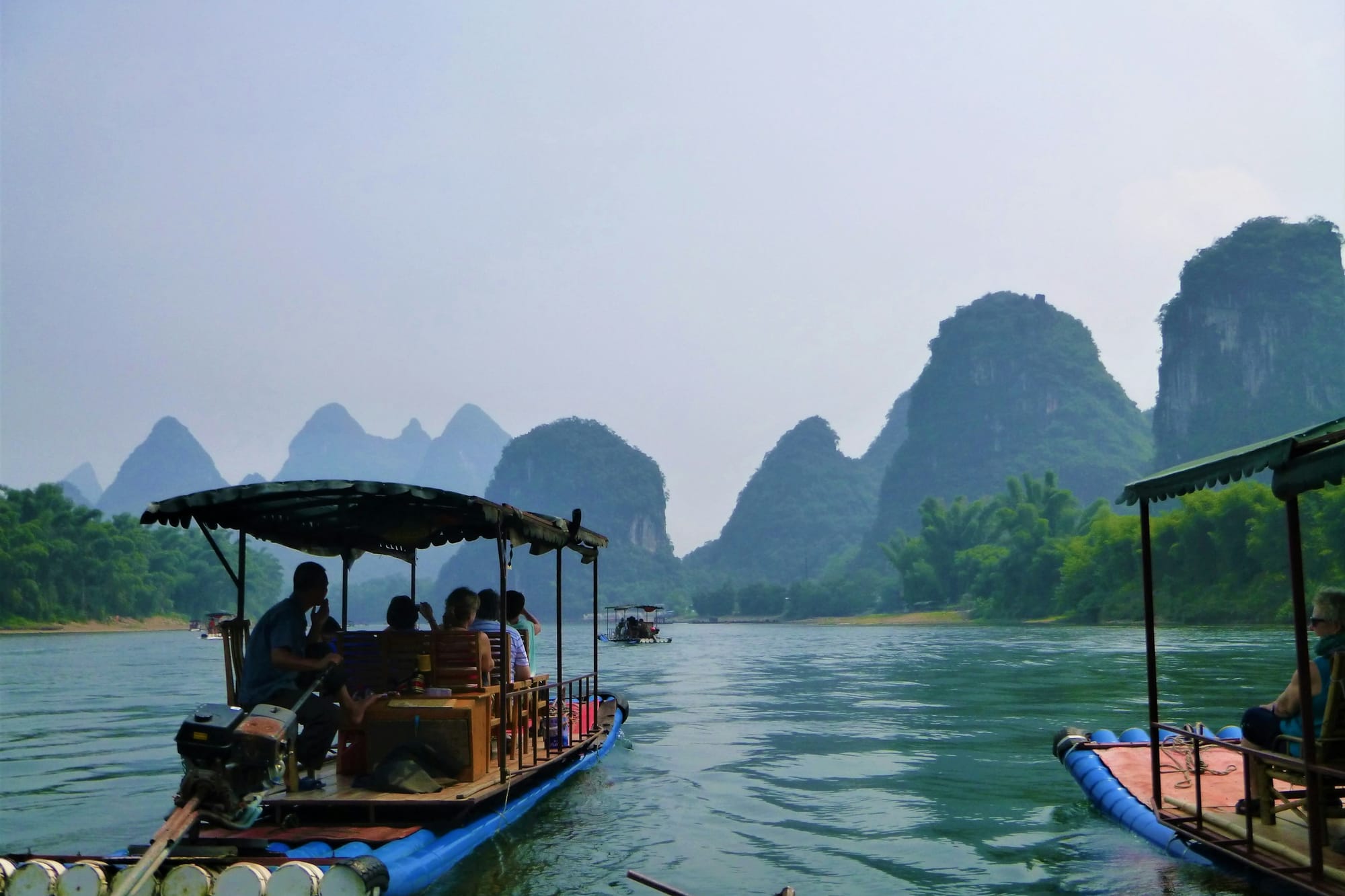
In Guangxi, the 2014 South China Karst inscription includes the Guilin Karst component, with tower (fenglin) and cone (fengcong) karst. We usually pair Guilin with Yangshuo. The South China Karst property also includes Wulong Karst in Chongqing and Shilin Karst in Yunnan.
In northwestern Hunan, the Wulingyuan scenic area within Zhangjiajie is described by UNESCO as more than 3,000 narrow sandstone pillars and peaks, many over 200 m high, with ravines, some 40 caves and two large natural bridges; the UNESCO page also links the Zhangjiajie UNESCO Global Geopark. We suggest planning two to three days in Zhangjiajie.
For mountain walks in eastern and south-western China, Huangshan in Anhui Province (Mount Huangshan, inscribed in 1990 as a mixed property) suits travellers who want a mountain-walking stay. Further west in northern Sichuan, UNESCO describes Jiuzhaigou as a valley rising above 4,800 m with conic karst landforms and waterfalls. Huangshan (Anhui), Zhangjiajie (Hunan) and Jiuzhaigou (Sichuan) are in provincial-level areas covered by 240-hour transit, and Guilin is one of the 12 named Guangxi cities, so these scenic areas can be combined with a transit stay.
Which Chinese cities suit food and living culture?
For food, we suggest Chengdu, a UNESCO City of Gastronomy since 2010 that UNESCO calls "the cradle and centre of Sichuan cuisine". For living culture, we suggest the old towns of Lijiang and Pingyao (both inscribed in 1997) and the grottoes of Datong (Yungang, 2001) and Luoyang (Longmen, 2000).
In Sichuan, Chengdu serves as an entry point for travellers exploring regional cooking through our food experiences. We usually pair Chengdu with Leshan for the Leshan Giant Buddha and Mount Emei; UNESCO inscribed Mount Emei, including the Leshan Giant Buddha Scenic Area, as a mixed property in 1996. Sichuan also has the Sichuan Giant Panda Sanctuaries (Wolong, Mt Siguniang and Jiajin Mountains), inscribed in 2006.
In Yunnan, we usually start from Kunming and continue to Dali and Lijiang. Inscribed on the World Heritage List in 1997, the Old Town of Lijiang keeps a historic townscape that blends several cultures, and UNESCO notes its ancient water-supply system still functions today. Further north in Shanxi Province, the Ancient City of Pingyao, inscribed in 1997, is described by UNESCO as a well-preserved traditional Han Chinese city founded in the 14th century, and the major banking centre for all of China in the 19th and early 20th centuries.
Travellers interested in monumental religious sculpture can focus on Datong and Luoyang. Datong is home to the Yungang Grottoes, inscribed in 2001, with 252 caves and 51,000 statues. In Henan Province, Luoyang has the Longmen Grottoes, inscribed in 2000, Buddhist grottoes and niches from the late Northern Wei and Tang dynasties (316–907). We suggest one of the two rather than both on a first trip.
Where can you follow the Silk Road or travel further west?
For the Silk Road, we suggest starting with Dunhuang in Gansu Province, home to the Mogao Caves (inscribed in 1987). UNESCO also lists the Silk Roads: the Routes Network of Chang'an-Tianshan Corridor (2014).
The Mogao Caves, located south-east of the oasis town of Dunhuang, were first constructed in 366 AD; UNESCO counts 492 cells and cave sanctuaries with statues and wall paintings spanning 1,000 years of Buddhist art. Because Dunhuang is in Gansu Province, it is outside the 240-hour transit areas, so a transit stay cannot include it; plan your entry route with that in mind.
Further west in the Xinjiang region, UNESCO lists Xinjiang Tianshan (2013); Xinjiang is also outside the 240-hour areas, so ask us about current travel conditions before planning it. For travel in the Tibet Autonomous Region, the Historic Ensemble of the Potala Palace in Lhasa was inscribed in 1994, 2000 and 2001. The US State Department (country page last updated 12 March 2026) says tourist travel to Tibet needs a special permit, separate from a Chinese visa, often obtained through a travel agent in China; the UK FCDO (updated 27 August 2026) says the permit comes through a specialist travel agent in China and travel must be on an organised tour.
Where should families and Hong Kong and Macau travellers go?
For families and travellers starting in the south, we suggest Hong Kong and Macau with Guangzhou and Shenzhen, or Xiamen for Kulangsu (inscribed in 2017). Hong Kong and Macau have entry systems separate from mainland China, so plan the crossing into your route.
In the Macao Special Administrative Region, the Historic Centre of Macao was inscribed on the World Heritage List in 2005, with Portuguese and Chinese buildings from its time under Portuguese administration (mid-16th century to 1999), plus a fortress and a lighthouse that UNESCO calls the oldest in China. Macao joined the UNESCO Creative Cities Network as a City of Gastronomy in 2017. For Hong Kong and Macau, you can review neighbourhood details on our Hong Kong page and our Macau page.
From Hong Kong we usually continue to Shenzhen and Guangzhou in Guangdong Province; nearby Shunde has been a UNESCO City of Gastronomy since 2014. For a coastal stop, we suggest Xiamen in Fujian Province for Kulangsu, a tiny island facing the city that became an international settlement in 1903 and was inscribed on the World Heritage List in 2017. Fujian also contains the mountain landscapes of Mount Wuyi (inscribed in 1999) and Fujian Tulou (inscribed in 2008). For families planning a trip with children, our China family tours are the same private tour, paced for families.
To review all potential regional stops and urban itineraries across the country, explore all our destination pages alongside our month-by-month planning resources in the when to visit China guide.
Plan your China trip with LocalKey
LocalKey can arrange a trip to any of these places. It is your own China trip — planned, booked and backed. It is not a group tour; we plan the route around your dates, pace and interests.
Travellers can select between two travel models on our private China tours:
- Independent: You travel on your own with the LocalKey app and 24/7 backup; there is no full-time guide, and a local guide, airport pickup or a private car and driver are optional add-ons on demand.
- Private Guided: An English-speaking private guide and a private car accompany you throughout the trip.
Every booking includes dedicated 1:1 specialist planning before departure and 7×24 WeChat or WhatsApp coordination while you are in China. Contact our consultants to begin designing your itinerary.
Sources
- UNESCO World Heritage Centre — China: properties inscribed on the World Heritage List (61), retrieved 7 October 2026 — verified_on 2026-10-07
- UNESCO — South China Karst — verified_on 2026-10-07
- UNESCO — Wulingyuan Scenic and Historic Interest Area — verified_on 2026-10-07
- UNESCO — Mausoleum of the First Qin Emperor — verified_on 2026-10-07
- UNESCO — Mogao Caves — verified_on 2026-10-07
- UNESCO — Yungang Grottoes — verified_on 2026-10-07
- UNESCO — Longmen Grottoes — verified_on 2026-10-07
- UNESCO — Old Town of Lijiang — verified_on 2026-10-07
- UNESCO — Ancient City of Ping Yao — verified_on 2026-10-07
- UNESCO — Jiuzhaigou Valley — verified_on 2026-10-07
- UNESCO — Historic Centre of Macao — verified_on 2026-10-07
- UNESCO — Kulangsu, a Historic International Settlement — verified_on 2026-10-07
- UNESCO Creative Cities Network — Chengdu, City of Gastronomy (2010) — verified_on 2026-10-07
- UNESCO Creative Cities Network — Macao, City of Gastronomy (2017) — verified_on 2026-10-07
- UNESCO Creative Cities Network — Shunde, City of Gastronomy (2014) — verified_on 2026-10-07
- National Immigration Administration — Visa-Free Transit Policies, 20 August 2026 — verified_on 2026-10-07
- National Immigration Administration — 240-hour transit permitted areas, 17 December 2024 — verified_on 2026-10-07
- US Department of State — China international travel information, last updated 12 March 2026 — verified_on 2026-10-07
- UK FCDO — China travel advice, updated 27 August 2026 — verified_on 2026-10-07