Riding a China bullet train is fast, level and practical: you book on 12306 with your passport, pass compulsory station security, board with the same ID, and sit in Second Class (3+2), First Class (2+2) or Business Class. On the Beijing–Shanghai line, selected services run at up to 350 km/h, with a fastest published band of about 4 hours 18 minutes to 4 hours 40 minutes.
Updated 30 September 2026 · LocalKey consultant team
The story
Short video clips on social media have turned China's high-speed rail network into a viral phenomenon. In fifteen-second reels, aerodynamic nose cones glide out of futuristic terminals, coins balance on edge on window ledges while digital displays tick up to 350 km/h, and countryside scenery blurs past in near silence. For travellers watching from abroad, the system appears almost science-fictional: an ultra-clean transit capsule floating across the landscape.
The reality of riding a Chinese bullet train is just as impressive in engineering, but it is fundamentally a practical mass-transit experience. It is not an exclusive luxury liner or an empty showroom. High-speed rail operates as the central transportation spine of modern China, moving millions of passengers across provinces every day. Stepping onto a platform means joining commuters reviewing spreadsheets, families balancing bags of local fruit, students heading home for the weekend, and seniors carrying vacuum flasks of hot tea.
The carriages are fast, punctual, and smooth. But they are also bustling public spaces with strict rules, distinct social etiquette, and security checkpoints that function more like airport terminals than traditional European train stations. Understanding what happens between booking your seat and reaching your destination turns an intimidating logistical challenge into one of the most efficient ways to explore the country.
What is it like to ride a Chinese bullet train?
The ride is level and smooth because high-speed lines use dedicated passenger tracks, continuous welded rail and wide curves, so a bottle on the window ledge barely ripples at 300 to 350 km/h. Speed depends on the corridor and the train: 350 km/h is the Beijing–Shanghai line's capability, not a promise for every service.
To understand what a high-speed rail journey feels like, consider the premier long-distance corridor in China: the route connecting Beijing and Shanghai. This line exemplifies modern Chinese passenger rail design and operational flow.
The physical sensation inside the train surprises most first-time passengers. Because high-speed lines run across dedicated passenger tracks constructed with continuous welded rail, wide curve radii, and elevated concrete viaducts, there is virtually none of the lateral rocking, wheel squeal, or vibration associated with older conventional rail lines. At cruising speed, the ride is remarkably level. The viral trick of balancing a coin, a lip balm tube, or a water bottle upright on the narrow window ledge really works; even as the train sweeps through provincial borders at 300 to 350 km/h, the liquid inside your bottle barely ripples.
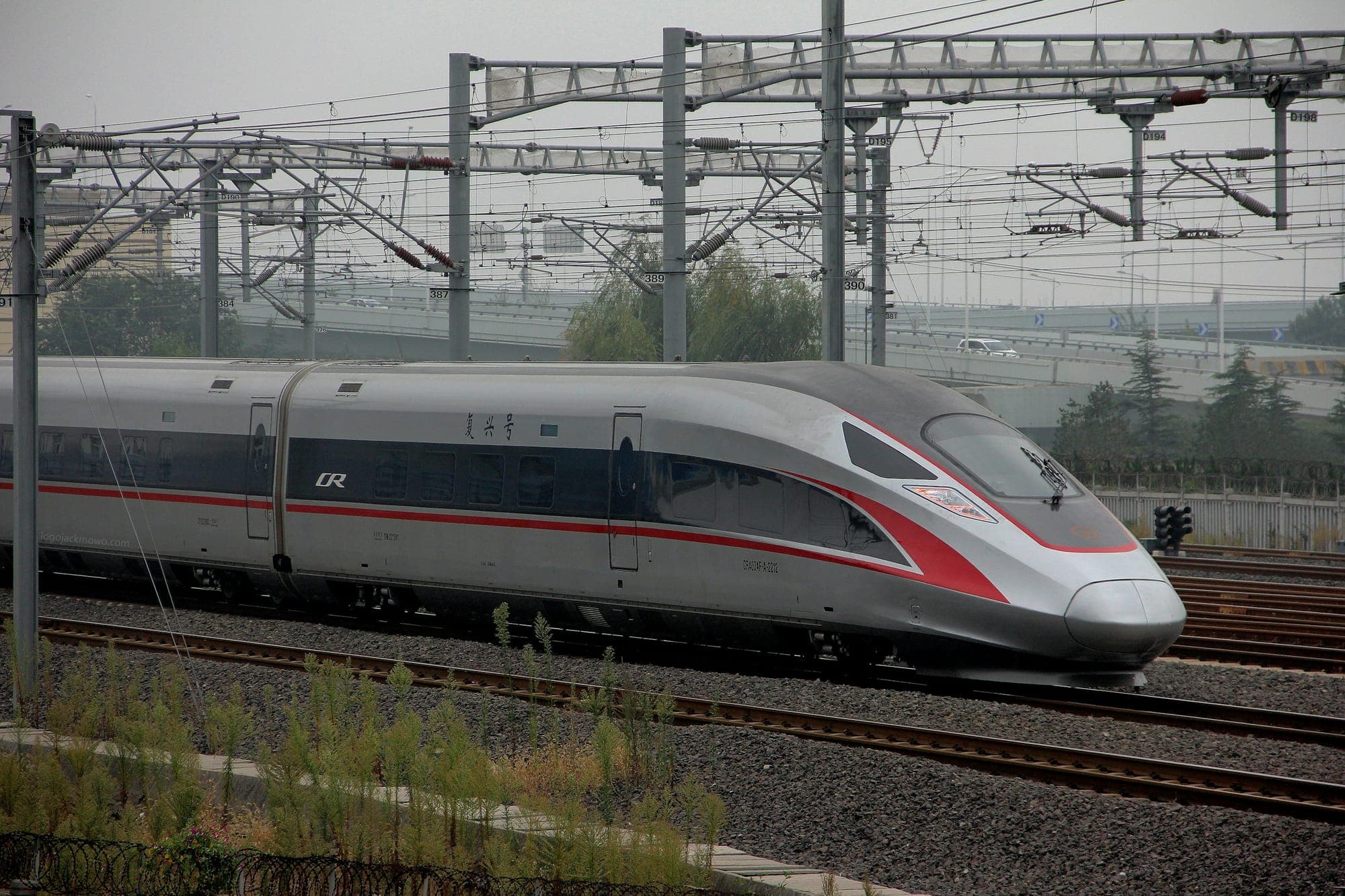
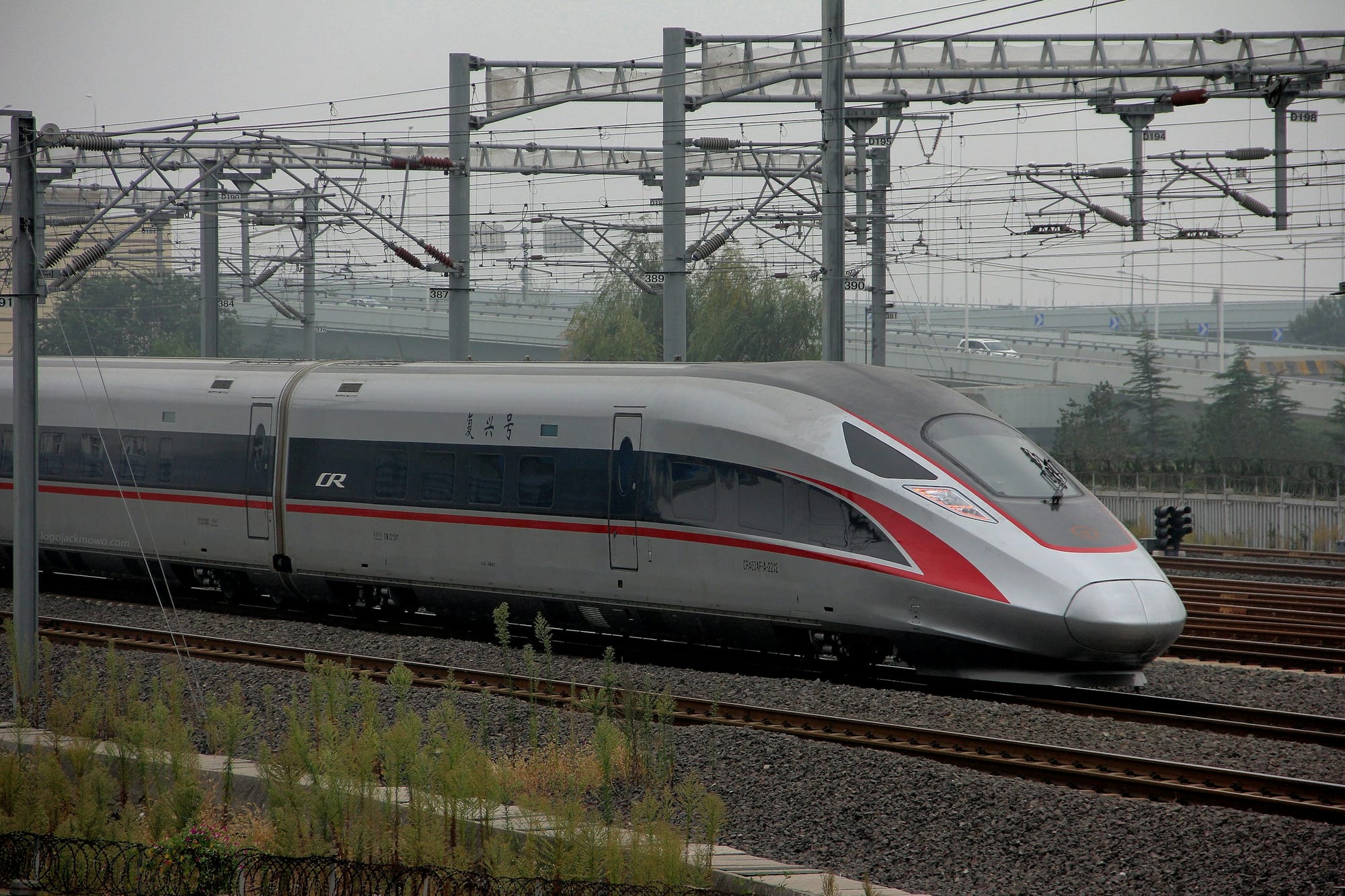
Speed, however, is a matter of corridor capability rather than a universal guarantee for every single train number. On the Beijing–Shanghai High-Speed Railway, the infrastructure has an official design and operating capability of up to 350 km/h. Selected flagship services—primarily G-category Fuxing train sets—reach this operating maximum on sustained straight sections, achieving the fastest published duration band of approximately 4 hours 18 minutes to 4 hours 40 minutes between Beijing South and Shanghai Hongqiao. Other services along the same corridor stop at intermediate cities such as Jinan or Nanjing, operating at slightly lower cruising speeds or spending longer decelerating, resulting in total travel times between 5 and 6 hours. Travellers should always treat 350 km/h as a corridor technical capability rather than an entitlement for every service, and check 12306 for live times and exact stopping patterns. As secondary references, both the Wikipedia corridor page and the Gaotie.net corridor page record the line's engineering specifications, but 12306 remains the sole source for live daily timetables. For deep operational detail on station terminals and route planning, see our dedicated guide to Beijing to Shanghai by HSR.
Cabins are pressurized to minimize ear discomfort in tunnels, though mild pressure shifts occur when passing opposing trains at closing speeds exceeding 600 km/h. Overhead digital screens cycle continuously through trip details: speed in kilometres per hour, carriage number, interior temperature, and upcoming station stops in Mandarin and English.
What seat classes are on China's bullet trains?
Long-distance bullet trains offer three main classes: Second Class with 3+2 seats, First Class with 2+2 seats, and Business Class with 1+2 or 1+1 lie-flat pods. Second Class holds most seats and still gives more legroom than airline economy.
Long-distance electric multiple unit (EMU) services offer three primary seating categories:
| Class | Seating layout | Legroom and comfort | Power and amenities | Best for |
|---|---|---|---|---|
| Second Class | 3+2 seats per row | Standard airline-plus legroom; reclining seat; fold-down tray | Shared power sockets under cushions; overhead luggage racks | Budget-conscious travellers and shorter journeys |
| First Class | 2+2 seats per row | Wider seats with generous legroom; footrest; deeper recline | Dedicated power sockets per seat pair; quieter cabin | Travellers working on laptops or wanting extra space |
| Business Class | 1+2 or 1+1 pods | Fully lie-flat leather shell seats; maximum personal privacy | Individual charging ports; reading light; complimentary tea and snacks | Premium travellers prioritizing quiet and rest on flagship routes |
Second Class accounts for the majority of seats on any train. The 3+2 layout places three seats on one side of the aisle and two on the other. While narrower than First Class, legroom easily exceeds economy airline seating, allowing adults to sit without knees touching the forward seatback. Overhead racks hold standard roll-aboard suitcases, while bulky bags fit into dedicated alcoves near carriage vestibules.
First Class arranges wider seats in a 2+2 pattern, eliminating middle seats. The cabin atmosphere is consistently quieter, making it ideal for reading or working on a laptop during daytime journeys.
Business Class represents the top tier of Chinese rail. Located in specialized quiet cars, Business Class features independent pods that recline into completely flat beds. Attendants serve hot tea, water, and snack boxes shortly after departure. While Business Class provides luxury, First and Second Class remain the backbone of the network and deliver generous comfort for long journeys. When mapping out multi-city routes, incorporating rail legs into a well-coordinated private China tour allows you to enjoy the speed of the train while leaving luggage transfers and station timing to local professionals.
The culture behind it
The bullet train has fundamentally reshaped modern Chinese geography and daily life. Before high-speed rail expanded nationwide, travelling between major cities required overnight sleeper trains or domestic flights subject to regular weather delays. Today, high-speed rail forms the default travel choice for business, education, and domestic tourism.
A key cultural advantage of high-speed rail is its terminal-to-terminal efficiency. Unlike commercial airports built far outside municipal centers, major railway stations connect directly to metropolitan subway networks. Departing from a city-center station and arriving directly at a downtown transit hub saves hours of highway travel.
The physical scale of Chinese railway stations reflects this mass-transit role. Mega-stations such as Beijing South, Shanghai Hongqiao, and Guangzhou South are monumental civic structures with soaring ceilings, natural light, and multi-level concourses separating arriving and departing passenger flows. These stations are bustling civic crossroads lined with bakeries, noodle shops, convenience stores, and tea stalls designed to handle tens of thousands of travellers simultaneously.
Onboard the trains, railway regulations maintain order across a dense travelling population. The electric multiple unit (EMU) fleet operates under strictly enforced quiet and safety rules:
- Strict non-smoking ban: The 12306 English FAQ states that smoking is strictly prohibited anywhere on EMU trains, and in the coaches of conventional trains. Treat the ban as absolute throughout the carriage and vestibules. Do not assume that a lavatory or gangway is an exception.
- Auditory etiquette: Onboard announcements remind passengers to use headphones when listening to audio or watching videos on personal mobile devices. While carriages are rarely silent, the prevailing atmosphere is orderly and purposeful. Phone calls are generally kept brief or taken in the vestibule area outside the main seating compartment.
- Luggage etiquette: Passengers stow their bags promptly upon boarding so aisles remain clear for passing beverage carts and train conductors. Heavy bags placed on upper racks must be secured within the rack boundary.
- Staff presence: Uniformed train attendants and conductors walk through the carriages regularly, monitoring cabin cleanliness, clearing waste bins, checking seat occupancy on electronic tablets, and ensuring luggage is safely stowed.
How do foreigners book and board a bullet train in China?
Book on the official 12306 English portal or app, entering your full name exactly as on your passport's machine-readable zone. At the station, security screening is compulsory, you board with the same valid ID used to buy the e-ticket, and an itinerary sheet is not a ticket.
Navigating the Chinese high-speed railway system as a foreign traveller is straightforward once you understand the basic operational flow. Keep your practical preparations focused on official channels and verified procedures:
- Booking your ticket: Link directly to 12306 train tickets for foreigners for complete account registration, name matching, and payment setup. The official 12306 English portal and mobile application are the definitive booking sources. Confirm the current booking window on 12306 for your travel date. Enter your full legal name exactly as shown on the machine-readable zone of your passport, with no punctuation or extra spaces.
- Station security and boarding: Follow the walkthrough on China train stations for foreigners. The 12306 English FAQ states that security screening is compulsory, that you board with the same valid ID used to buy the e-ticket, and that an itinerary sheet is not a ticket. Allow enough time for walks and queues at a major station.
- Connecting primary hubs: For city guides exploring what to see before or after your ride, check our destination resources for Beijing and Shanghai.
- Short regional hops: Bullet trains also serve short regional connections. Review our guide to Shanghai to Hangzhou by HSR to see how high-speed trains cover regional distances in under an hour.
- Sample multi-city itinerary: If you are planning an extended trip across historic and modern centers, explore the Beijing Xi'an Shanghai private tour, which pairs bullet train travel with door-to-door ground support.
- Food and dining on board: Long-distance high-speed services commonly offer more than one way to eat without leaving the train, though exact menus and stock vary by train and date:
- Dining area: Many EMU formations include a dining or service carriage with a counter for packaged meals, tea, coffee, water, and snacks. Carriage numbering differs by formation length; ask attendants if you cannot find it.
- Trolley service: Attendants often pass through Second and First Class with bottled drinks, packaged snacks, and meal trays at meal times.
- Smart Fuxing dining-car vending: A June 2021 China Railway passenger-service briefing, reported by The Paper, described self-service vending in the dining car of intelligent Fuxing CR400AF/CR400BF sets for fruit, drinks, and snacks.
- Hot water: Carriages commonly provide hot-water points for tea or instant noodles. Bring drinking water and a few preferred snacks anyway; popular items can sell out on busy services. We do not list prices because they change.
Build this trip with LocalKey
Travelling China by bullet train is one of the most practical ways to cover long distances between major cities while keeping city-center arrivals. LocalKey designs seamless rail journeys across China, removing the friction of ticket booking, luggage logistics, and station transfers through our private China tours.
- Independent: your own China trip — planned, booked, and backed. You travel with the LocalKey app and 24/7 backup, with optional add-ons such as airport pickup, a private car and driver on demand, or a local guide on demand. This suits travellers who want rail days at their own pace with specialist support behind the bookings.
- Private Guided: private guides and a driver with car across the trip. This suits travellers who want local interpretation and smoother station-to-hotel transfers between Beijing, Shanghai, and other stops on a multi-city rail route.
Every journey is supported by a dedicated 1:1 travel specialist and round-the-clock 7×24 WeChat and WhatsApp assistance. Reach out through our contact page to begin planning your personalized route across China.
Sources
- 12306 English FAQ — real-name ticketing, e-ticket and passport for check-in/boarding, itinerary sheet is not a ticket, compulsory security, EMU smoking ban, luggage limits. Verified 30 September 2026.
- 12306 English portal — official booking and enquiry channel. Verified 30 September 2026.
- China Railway: Fuxing EMU Train Service Covers Henan Province — Fuxing CR400BF-A example seating (business, first, second). Verified 30 September 2026.
- The Paper report on China Railway smart Fuxing briefing (22 June 2021) — dining-car vending for fruit, drinks, and snacks on CR400AF/CR400BF. Verified 30 September 2026.
- Wikipedia: Beijing-Shanghai high-speed railway — corridor length and 350 km/h operating context (secondary). Verified 30 September 2026.
- Gaotie.net: Beijing-Shanghai high-speed railway corridor — corridor overview (secondary). Verified 30 September 2026.
- LocalKey: Beijing to Shanghai High-Speed Rail for Foreigners 2026 — Verified 30 September 2026.
- LocalKey: China Train Stations for Foreigners 2026 — Verified 30 September 2026.
- LocalKey: 12306 Train Tickets for Foreigners — Verified 30 September 2026.
- LocalKey: Shanghai to Hangzhou by High-Speed Rail 2026 — Verified 30 September 2026.
- LocalKey: Beijing Xi'an Shanghai Private Tour — Verified 30 September 2026.