Updated 2 October 2026 · LocalKey consultant team
The best way to experience Macau is to combine a walk through the UNESCO-listed Historic Centre of Macao with a planned introduction to Macanese food, then connect the city to Hong Kong, Zhuhai or Guangzhou as part of a wider Greater Bay Area journey.
What is the Historic Centre of Macao, and why is it a UNESCO World Heritage site?
The Historic Centre of Macao is a group of 22 principal buildings and public spaces inscribed on the UNESCO World Heritage List in 2005 under criteria (ii), (iii), (iv) and (vi). It records the meeting of Portuguese and Chinese architectural, religious, cultural and trading traditions in Macau.
UNESCO describes Macau as a major port that was under Portuguese administration from the mid-16th century until 1999, when it came under Chinese sovereignty. The historic area is therefore not one isolated monument but an urban route: squares, narrow streets, religious buildings, civic spaces, fortifications and residential fabric that developed around a long-running East–West encounter.
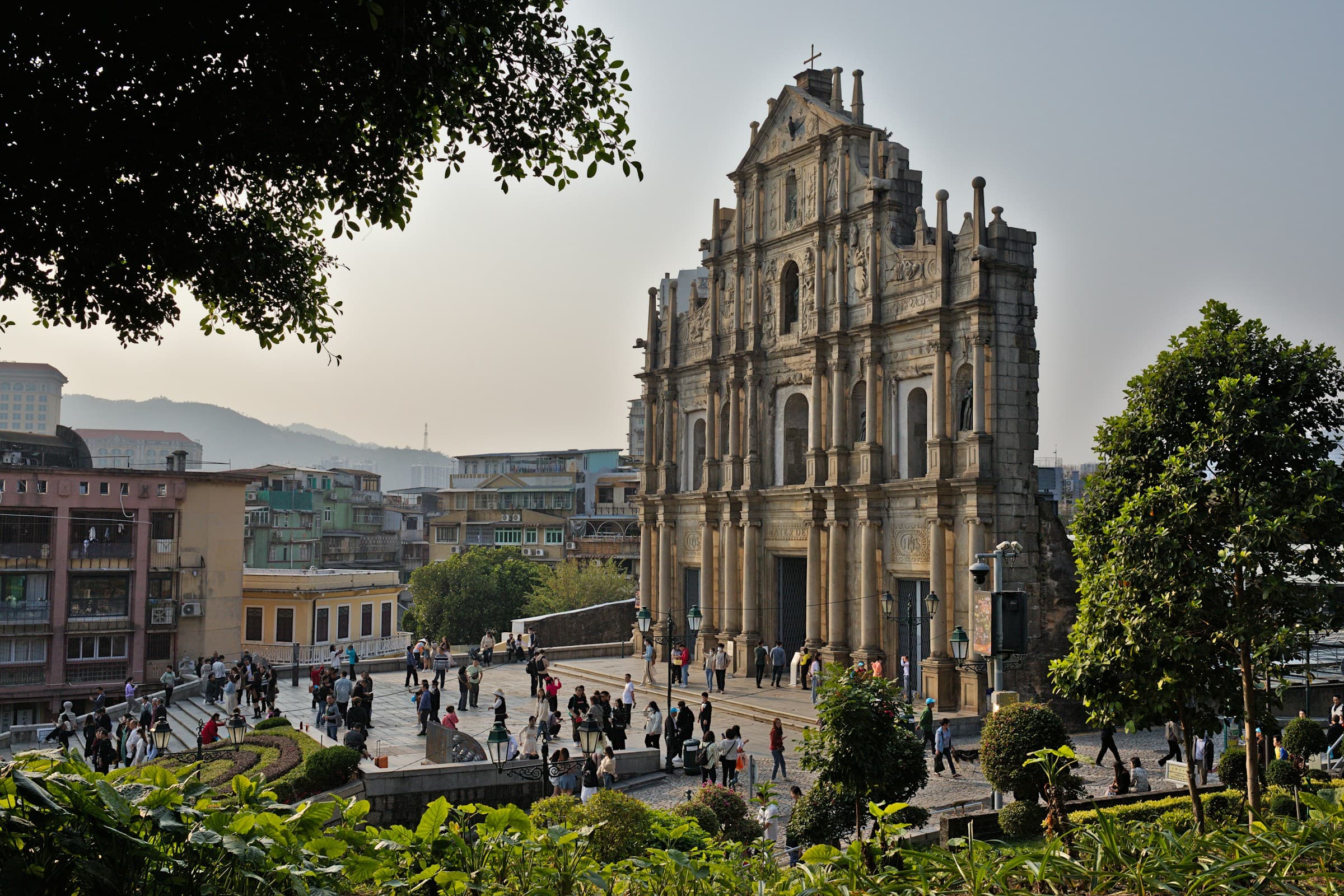
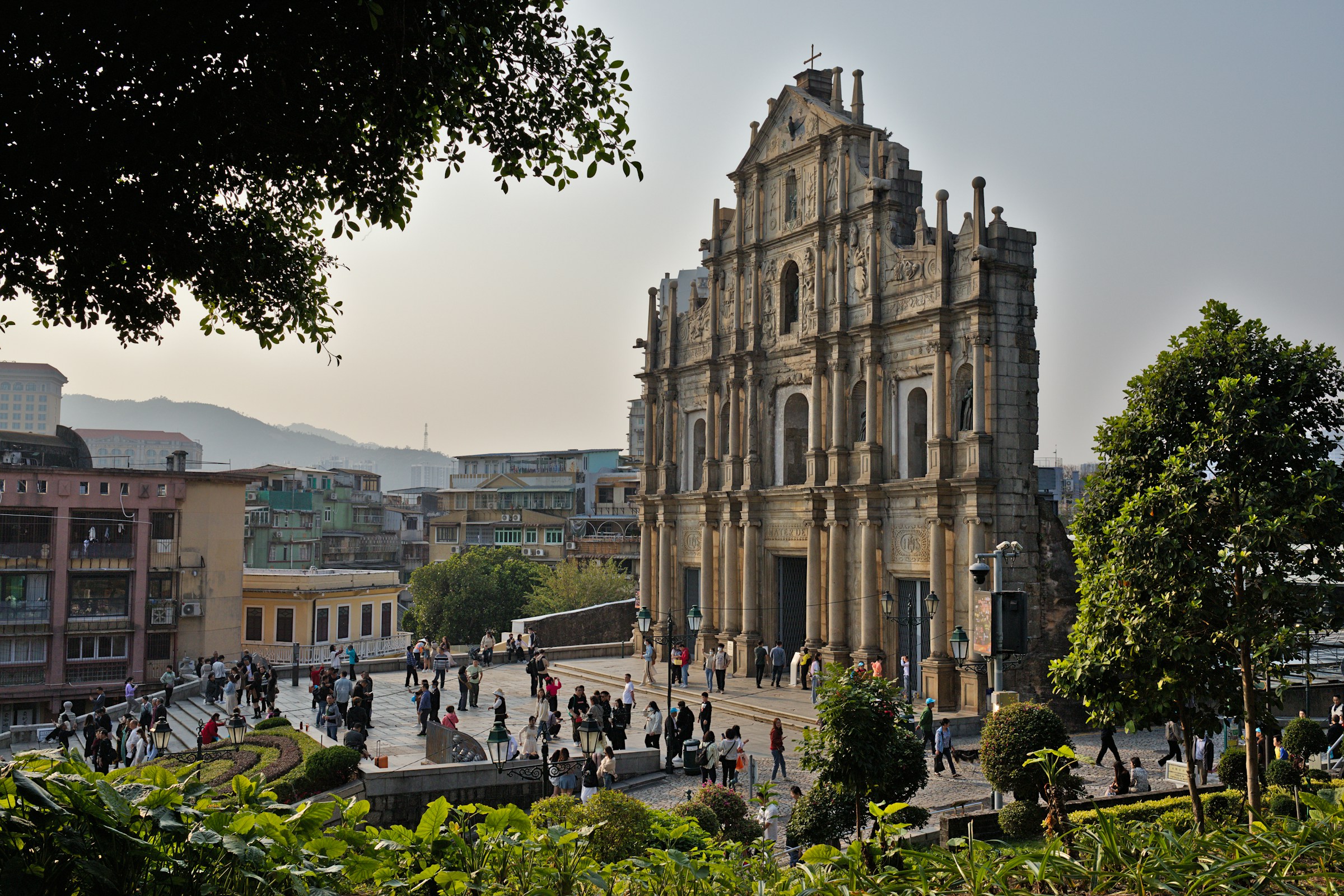
The heritage story is easiest to understand on foot. Start at Senado Square, where the paved public space leads towards St. Dominic's Church and the Ruins of St. Paul's. Continue uphill to Mount Fortress for a broader view over the old city. A separate extension of the day can reach A-Ma Temple near the southern waterfront, while Guia Fortress, including Guia Lighthouse, gives context for Macau's maritime position. UNESCO identifies the lighthouse as the oldest in China.
The Cultural Affairs Bureau's World Heritage overview is useful for current interpretation and site context. The complete designation, inscription year and criteria are recorded by the UNESCO World Heritage Centre.
This sequence works because it moves from civic space to religious architecture, then to military and maritime viewpoints. It also leaves room for food stops without turning the heritage district into a checklist. Macau's historic centre remains a living part of the city, so visitors should allow space for worship, local movement and ordinary neighbourhood life.
What is Macanese food, and how is it different from Portuguese or Cantonese cooking?
Macanese cuisine developed from a Portuguese base, Chinese ingredients and culinary skills, and food influences carried through African, Indian and Southeast Asian maritime routes. It is related to Portuguese cooking and Cantonese food, but it is a distinct family-based cuisine shaped in Macau over centuries.
The key difference is the way ingredients and methods were adapted at home. Portuguese dishes and techniques met Chinese cooking skills, while spices and ingredients such as curry, coconut milk, cloves and cinnamon entered the culinary repertoire through maritime connections. Macanese families developed recipes over generations, producing dishes that cannot be reduced to either Portuguese or Cantonese cooking.
The official Macao Gastronomy site identifies Galinha à Africana, or African chicken, and Macanese chilli shrimps among the best-known dishes — both show how spice routes and household cooking shaped Macanese tables. Other useful dishes to look for include:
- Minchi, a Macanese minced meat dish commonly served with rice and other simple accompaniments.
- Pastéis de nata, Portuguese egg tarts that originated in Portugal and became popular in Macau.
- Serradura, a chilled dessert made with cream and crushed biscuit.
A thoughtful tasting does not need to cover every dish in one sitting. Begin with one savoury preparation that shows the spice profile, add Minchi for a more substantial meal, and finish with an egg tart or serradura. Recipe names and preparation vary between households and kitchens, so a local explanation is often more valuable than ordering by reputation alone.
Macanese Gastronomy was added to the Macao Intangible Cultural Heritage List in 2012 and to the Representative List of National Intangible Cultural Heritage in 2021, according to the official gastronomy site. For further background, it also lists António M. Jorge da Silva's book Macanese Cuisine Origins and Evolution, which examines the origins, changing ingredients and development of Macanese dishes.
Macau was designated a UNESCO Creative City of Gastronomy on 31 October 2017. The Macao Government Tourism Office and the Macao SAR government announcement provide additional context for that designation.
What should you eat and see on a Historic Centre food-and-heritage day?
A practical day combines Senado Square, St. Dominic's Church, the Ruins of St. Paul's and Mount Fortress with a planned Macanese meal and one or two smaller tastings. The route is compact in concept but includes steps, slopes and busy pedestrian areas, so pacing matters.
A useful structure is:
- Morning heritage walk: Begin at Senado Square and follow the historic route towards St. Dominic's Church and the Ruins of St. Paul's. Read the streets as part of the site rather than moving directly between monuments.
- Late-morning pause: Take time for a light local snack or coffee before continuing uphill. This keeps the main meal flexible and avoids rushing through the central monuments.
- Mount Fortress: Visit the fortress area for the relationship between the old city, defensive infrastructure and Macau's port history.
- Macanese lunch: Choose a meal centred on one or two dishes such as African chicken, chilli shrimps or Minchi. Add a dessert rather than ordering a large spread if you plan to continue walking.
- Afternoon extension: Continue to A-Ma Temple or arrange a separate visit to Guia Fortress and Guia Lighthouse, depending on energy, weather and the rest of your itinerary.
- Evening meal or dessert: Use this as a second chance to try a dish missed earlier, rather than duplicating the same style of meal.
Wear shoes suitable for uneven paving and slopes. Carry water, and allow more time than a map suggests when visiting during busy periods. Some heritage interiors and food businesses may have changing access arrangements, so check official listings or confirm locally before making the route fixed.
For a broader destination overview, see the Macau Travel Guide for a China Trip 2026. LocalKey can also plan a dedicated Macau food experience around the heritage route.
How do you fit Macau into a Greater Bay Area China trip?
Macau SAR works well as a focused heritage-and-food stop within a Greater Bay Area itinerary, especially when combined with Hong Kong, Zhuhai or Guangzhou. The right order depends on your arrival point, entry permissions, luggage and whether Macau is a day visit or an overnight stay.
From Hong Kong, travellers can plan a direct Macau connection or use the Hong Kong–Zhuhai–Macau transport corridor, subject to current border and ticket arrangements. From Zhuhai, Macau is a natural cross-border pairing, while Guangzhou can be connected through the wider regional transport network. Exact schedules and crossing requirements should be checked close to travel because they can change.
Treat each border crossing as a real itinerary transition. Your passport, visa or transit permission may need to cover the relevant parts of the journey, and entry rules can differ between Mainland China, Hong Kong and Macau SAR. Read the Hong Kong, Macau and China Visa & Re-entry 2026 guide before finalising a multi-entry route.
For a northbound itinerary, Macau can follow Hong Kong and lead into Zhuhai and Guangzhou. For a southbound itinerary, it can be a final heritage stop before Hong Kong. Travellers who prefer fewer hotel changes may stay in Macau for two nights and make the historic centre the anchor of one full day.
See the practical route guide for Macau to Zhuhai and Guangzhou 2026. LocalKey also maintains a destination page for Macau.
How do Independent and Private Guided trips include Macau SAR?
LocalKey includes Macau in two private China tour formats: Independent, with an app and 24/7 backup, and Private Guided, with private guides and driver/car across the trip. Both can include Macau hotels, heritage planning, food arrangements and connections to Hong Kong, Zhuhai or Guangzhou.
With Independent travel, your own China trip — planned, booked and backed — is organised around a clear route in the app, with 24/7 backup when plans need adjusting. Optional add-ons include airport pickup, a car-driver service or a local guide on demand. This suits travellers who want flexible time in the Historic Centre while keeping the logistics supported.
With Private Guided travel, private guides and driver/car support are arranged across the trip. A guide can explain the relationship between the monuments, manage the walking pace, interpret Macanese dishes and coordinate the border or regional transfer plan. LocalKey arranges Macau and Hong Kong segments directly, including hotels, guides and transfers.
Explore Independent travel or Private Guided travel, within our wider private China tours. To discuss the right pacing, contact a 1:1 specialist through 7×24 WeChat or WhatsApp.
Sources
All sources verified on 2026-10-02.
- UNESCO World Heritage Centre: Historic Centre of Macao
- Cultural Affairs Bureau: World Heritage
- UNESCO Creative Cities Network: Macao
- Macao Government Tourism Office: Macao, Creative City of Gastronomy
- Macao SAR Government: Macao designated as UNESCO Creative City of Gastronomy
- Macao Gastronomy: Macanese cuisine and cultural heritage