Updated 5 October 2026 · LocalKey consultant team
Take a high-speed train from Chongqing East to Wulong South (35–57 minutes on 12306's listing for 9 October 2026, first train 07:17 arriving 08:02), take the bus to the visitor reception centre in Xiannu town, and spend the day at the Three Natural Bridges. One main site makes a relaxed day; add the Longshuixia Fissure only with an early train and tickets already booked.
Wulong is the third-day option in our Chongqing itinerary for two or three days. It works best when you organise the rail journey and scenic transport before leaving Chongqing, then keep the site plan simple.
How do you get from Chongqing to Wulong by train?
The Chongqing East–Qianjiang section of the Chongqing–Xiamen high-speed railway opened on 27 June 2025, and it includes Wulong South station, according to the Chongqing Municipal People's Government. For travel on 9 October 2026, a 12306 query on 5 October 2026 listed 15 direct trains from Chongqing East to Wulong South, taking 35–57 minutes, with the first at 07:17.
Chongqing East is the most useful departure point for this day trip. The new line also serves Banan, Nanchuan North, Shuijiang West, Pengshui West and Qianjiang. The line was designed for trains operating at up to 350 km/h and covers 242 km between Chongqing East and Qianjiang, but the useful detail for visitors is the direct stop at Wulong South.
For the return, 12306 listed 13 trains from Wulong South to Chongqing East on the same date. The journey time was 37–52 minutes, with the last listed departure at 21:25, arriving at 22:10. These are the reference times for 9 October 2026 rather than a permanent timetable, so check 12306 again for your own travel date.
| From | To | Journey time listed by 12306 (9 Oct 2026) | Notes |
|---|---|---|---|
| Chongqing East | Wulong South | 35–57 min | 15 direct trains that day; first 07:17 |
| Wulong South | Chongqing East | 37–52 min | 13 trains; last 21:25 |
| Chongqing West | Wulong South | About 1 h 40–1 h 55 | Slower than Chongqing East |
| Chongqing North | Wulong South | About 1 h 55–2 h 25 | Slower than Chongqing East |
| Conventional trains | Wulong (older station) | 1 h 50–2 h 45 | Slower; not Wulong South |
Your ticket should be for Wulong South, not simply Wulong station. The high-speed station is the practical arrival point for the Xiannushan tourist connections. If you are staying around Jiefangbei, Yuzhong or another central district, allow time to cross the city to Chongqing East before the train. See how to get around Chongqing for station access and city transport planning.
Book the train through 12306 train tickets for foreigners. You do not need to build the day around a particular train number, but an early departure gives you the best chance of adding Longshuixia after the bridges. Services, departure times and seat availability change, so use 12306 for the exact date.
The Chongqing Municipal People's Government also records new tourist transport at Wulong South, including the Xiannushan “Star” tourist line and a Jiangkou Furong Cave scenic bus line. For the usual Three Natural Bridges day, follow the signs for the Xiannushan resort connection and confirm the current boarding arrangement at the station.
How do you get from Wulong South station to the Three Natural Bridges?
From Wulong South, take a bus to the visitor reception centre in Xiannu town, then a scenic transfer bus from the centre to the site, according to the scenic-area operator, Chongqing Wulong Karst Tourism Group. The Three Natural Bridges ticket includes the scenic transfer bus from the visitor centre and the Tianlong spiral lift that takes visitors down to the bridges.
At Wulong South, the Chongqing Municipal People's Government records the Xiannushan “Star” tourist line launched at the station, and the Wulong District government lists the visitor reception centre as a stop on the Xiannushan resort buses. Plan it as two legs: first the resort bus to the centre in Xiannu town, then the scenic transfer buses, which the operator says run from the centre to each site.
The Three Natural Bridges route is one-way. You enter at one point, take the Tianlong spiral lift, walk through the karst valley and leave away from the entrance. Do not assume that returning to the starting gate is part of the route. Follow the signs for the onward scenic transport when you reach the exit.
The Tianlong spiral lift is included in the Three Natural Bridges ticket. The exit electric cart is separate, so decide whether you want to use it when you reach that part of the route. The operator's ticket information also states that the Longshuixia Fissure ticket includes its scenic transfer bus and lift.
The operator advises buying scenic tickets and sightseeing-bus tickets in advance through the official platform when possible. LocalKey's own advice: keep the booking details and the passport used for the booking with you.
The Three Natural Bridges walk is about 2 km and mainly downhill, according to Chongqing Wulong Karst Tourism Group. The route is manageable for many visitors, but it is not a flat, station-to-station visit. Wear shoes with a secure sole and keep enough space in your day for the exit transfer.
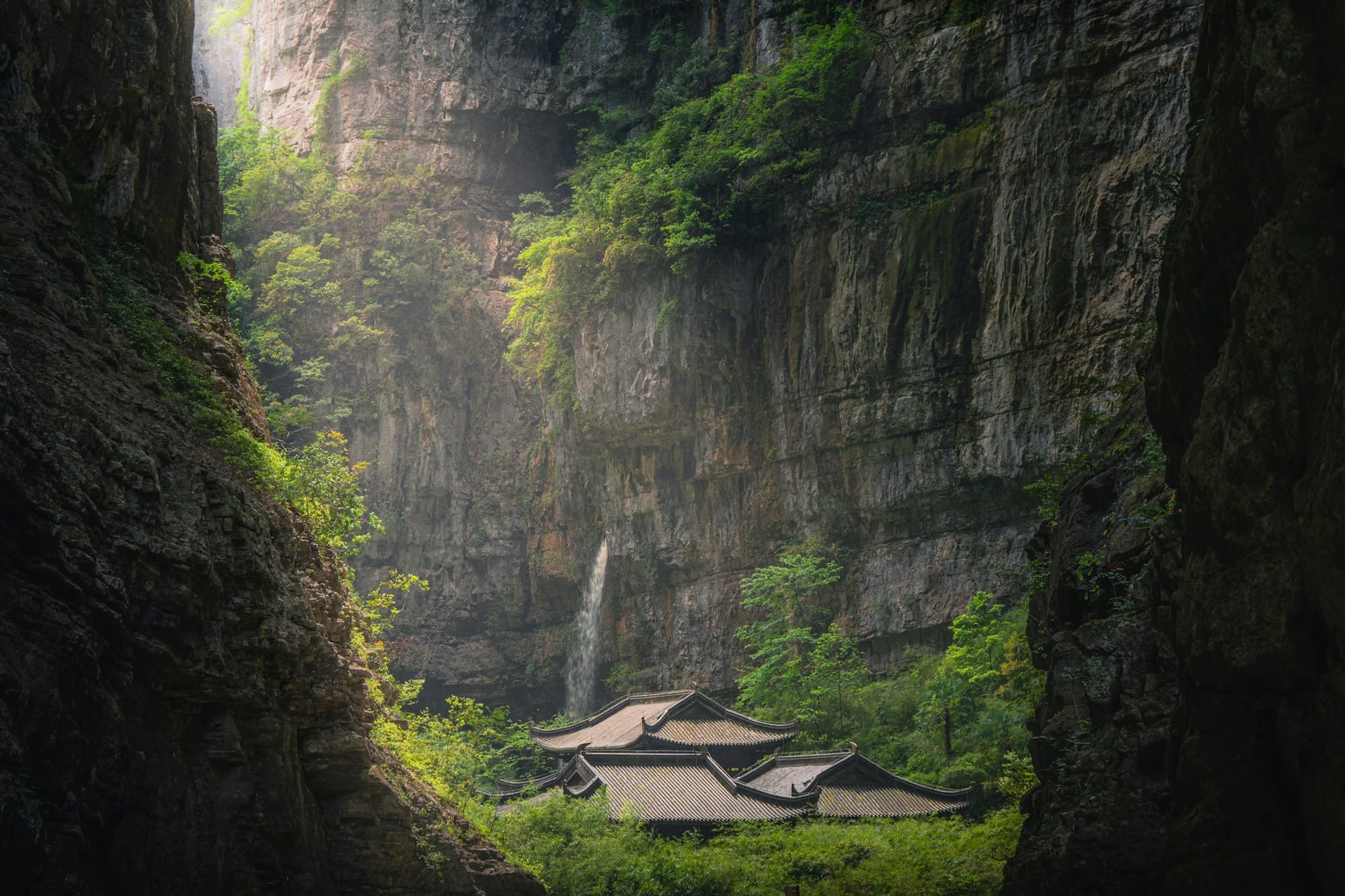
The operator describes Tianlong, Qinglong and Heilong as Asia's largest group of natural bridges.
How long does a Wulong day trip take?
A Chongqing day trip to Wulong combines a high-speed train each way, the station-to-centre connection, scenic transfer buses and walking. Allow 3–4 hours at the Three Natural Bridges (the operator's June 2025 guide; its September 2026 guide gives about 3 hours).
The Three Natural Bridges alone is the comfortable choice for a first day from Chongqing. The route has a fixed direction, a lift descent and an exit transfer to manage. Add the train and the two levels of bus connection, and the day becomes full without needing another major attraction.
Longshuixia Fissure takes about three hours. It is a 5 km-long fissure with a depth of roughly 200–500 m, and its ticket includes the relevant transfer bus and lift. Xiannushan also takes about three hours, while Furong Cave takes about two hours. These are separate choices rather than small add-ons beside the bridges.
Two main sites can work only with an early train, efficient transfers, suitable conditions and tickets already arranged. Even then, leave a buffer for queues, the one-way route and the return to Wulong South. A delayed first connection can turn a two-site plan into a rushed one.
A simple day plan is:
- Take an early train from Chongqing East to Wulong South.
- Follow the tourist connection to the visitor reception centre in Xiannu town.
- Take the scenic bus to the Three Natural Bridges and use the allowance above for the route.
- Add Longshuixia Fissure only if you have reached the centre early enough and the next transfer fits comfortably.
- Return to Wulong South and take a return train before the last listed service for your date.
The operator suggests two days and one night for a fuller visit. Staying in the Xiannushan resort is the closest base to the core sites, while Wulong town is about 30 minutes from them. For a short Chongqing stay, however, one main site is generally the better balance between seeing the landscape and spending the entire day in transit.
Wulong is also the main alternative to Dazu Rock Carvings when choosing a day trip from Chongqing. Dazu is a different type of outing, centred on carved cliff complexes rather than karst bridges and fissures.
When is the best time to visit Wulong?
The scenic-area operator, Chongqing Wulong Karst Tourism Group, describes March–October as the high season and November–February as the low season. Holidays and summer are busy, so the operator advises setting off early; mountain weather can change quickly, and a windproof layer is useful.
Season affects both crowd levels and the feel of the wider area. The operator describes spring at Xiannushan through its flowers, summer as a cooler mountain escape, autumn through leaf colour and winter through snow. The Three Natural Bridges and Longshuixia are still the main practical choices for a day trip, but Xiannushan can be a better seasonal addition if you are staying longer.
Leave more flexibility around public holidays and the summer. An early train is especially important if you hope to see Longshuixia as well as the bridges.
Heavy rain can change the plan completely. On 7 June 2026, the operator reported flooding on access roads and temporarily closed the Three Natural Bridges, Longshuixia Fissure, Furong Cave and Furong River. The bridges and Longshuixia reopened on 8 June, while Furong Cave reopened on 27 September 2026 after a power-cable repair.
Check current notices before departure, particularly after heavy rain. The official enquiry hotline is 400-023-5666. A ticket or train reservation does not guarantee that a scenic route will operate if conditions create a safety closure, so keep your Chongqing days in an order that can be adjusted.
For a broader city-and-nature plan, see our Chongqing city page. For families, our China family tours planning can take account of stairs, walking distance and lifts when deciding whether to include both sites.
What should you book before a Wulong day trip?
Before leaving Chongqing, book the train on 12306 and reserve scenic tickets and sightseeing-bus tickets through the official platform where available. The scenic-area operator, Chongqing Wulong Karst Tourism Group, states that the Three Natural Bridges, Furong Cave and Xiannushan are separately ticketed, with combined tickets also available.
Check that every booking matches your intended site. A Three Natural Bridges ticket covers its scenic transfer bus from the visitor centre and the Tianlong spiral lift, while the Longshuixia ticket covers its own transfer bus and lift. The exit electric cart at the bridges is separate. Furong Cave is sold with a cableway option.
Bring the passport used to book the train or scenic tickets, and keep the booking references on your phone. Wear comfortable shoes: the operator describes the Three Natural Bridges route as about 2 km and mainly downhill.
Wulong Karst forms part of the South China Karst World Heritage site, which UNESCO inscribed in 2007 for its giant dolines, natural bridges and caves. The operator identifies Wulong as a core area of that World Heritage site. This is a geological landscape first, so plan around the physical route rather than treating the bridges as a quick roadside stop.
Before confirming a two-site day, check three things: the first available train, the current scenic notices and the return services from Wulong South. If any one of those is uncertain, keep the Three Natural Bridges as the core visit and treat Longshuixia as optional.
For photography-specific planning, use our Wulong Karst photography guide and our photography experiences. This article keeps the focus on transport, tickets and timing rather than light, framing or equipment.
Plan this with LocalKey
Choose Independent if you want to travel on your own with the LocalKey app and 24/7 backup. Add-ons are available on demand, including airport pickup, a private car and driver, or a local guide. The guide is optional, so you can keep the day self-directed while having help with the rail and scenic connections when needed.
Choose Private Guided for a private guide and driver/car across the trip. For Wulong, that can mean a car from your Chongqing hotel or Wulong South to the visitor centre, a guide who handles tickets and transfer buses, and a pace that suits everyone.
Either way, it is your own China trip — planned, booked and backed. See how our private China tours work. Speak with a 1:1 specialist through 7×24 WeChat or WhatsApp if you are weighing Wulong against Dazu, fitting the visit into a two-day Chongqing itinerary or travelling with children and older relatives.
Sources
- Chongqing Municipal People's Government — Chongqing East–Qianjiang high-speed railway opening — verified_on 2026-10-05: https://www.cq.gov.cn/ywdt/jrcq/202506/t20250626_14746530.html
- China Railway 12306 — timetable query — verified_on 2026-10-05: https://www.12306.cn/
- Chongqing Municipal People's Government — Wulong South station transport — verified_on 2026-10-05: https://cq.gov.cn/ywdt/zwhd/qxdt/202506/t20250619_14725495.html
- Chongqing Wulong Karst Tourism Group — Wulong Karst visitor guide — verified_on 2026-10-05: https://www.wlkst.com/qtmj/20250613/27402.html
- Chongqing Wulong Karst Tourism Group — ticket information — verified_on 2026-10-05: https://www.wlkst.com/pjdq.jhtml
- Chongqing Wulong Karst Tourism Group — National Day 2026 guide — verified_on 2026-10-05: https://www.wlkst.com/wlxw/20260928/27984.html
- Chongqing Wulong Karst Tourism Group — closure and reopening notices — verified_on 2026-10-05: https://www.wlkst.com/wlxw/20260607/27873.html ; https://www.wlkst.com/wlxw/20260926/27981.html
- UNESCO World Heritage Centre — South China Karst — verified_on 2026-10-05: https://whc.unesco.org/en/list/1248/