Updated 2 October 2026 · LocalKey consultant team
Travellers can still visit the real Hong Kong SAR places Wong Kar-wai used in Chungking Express (1994) — especially Chungking Mansions in Tsim Sha Tsui and the Central–Mid-Levels Escalator. Add the Central and Lan Kwai Fong streets around the former Midnight Express snack bar for a walkable culture day in the Greater Bay Area, the cluster of Hong Kong SAR, Macau SAR, Guangzhou, Shenzhen, Zhuhai and Foshan.
Wong Kar-wai’s film is often remembered through motion, music, crowded interiors and fleeting encounters. Yet its locations remain unusually accessible. You do not need a film set reconstruction or a themed attraction: the buildings and streets are part of ordinary Hong Kong SAR life, with residents, workers, shops, commuters and visitors moving through them every day.
The practical distinction matters. Some businesses shown in the film have changed or disappeared, while the larger neighbourhoods and public infrastructure remain. This guide separates the film’s story from the places you can visit now, then shows how to fit the walk into a wider China itinerary.
Where was Chungking Express filmed in Hong Kong SAR?
Chungking Express was filmed across two linked Hong Kong location areas: Chungking Mansions in Tsim Sha Tsui for the first love story, and Central streets, the former Midnight Express neighbourhood and the Central–Mid-Levels Escalator for the second. Wong Kar-wai used these real places to connect two separate stories set in 1990s Hong Kong. (Film overview and locations, Wong Kar-wai on the locations)
The film has two main narratives rather than one continuous plot. The first follows a police officer after a breakup and his encounter with a woman connected to Chungking Mansions. The second follows another police officer and his changing relationship with a worker at the Midnight Express snack bar. The stories are separate but share a sense of passing time, missed connections and people living close together without necessarily knowing one another.
The title points directly to the geography. “Chungking” refers to Chungking Mansions, the large mixed-use complex at 36–44 Nathan Road in Tsim Sha Tsui. “Express” refers to Midnight Express, the Central snack bar associated with the second story. The snack bar is gone; the Lan Kwai Fong and D’Aguilar Street area remains the neighbourhood to explore today.
Wong Kar-wai has described writing lines near the former Holiday Inn on Nathan Road and filming around Chungking Mansions and Mirador Mansions. The Central–Mid-Levels Escalator appears outside the apartment associated with the second story, giving the film a physical link between private rooms, steep streets and the city’s daily movement. (BFI location feature, Filmmaker Magazine interview)
For visitors, the strongest route is therefore not a hunt for a single unchanged storefront. It is a sequence through two urban environments: Tsim Sha Tsui’s Nathan Road and Chungking Mansions, followed by Central’s streets, escalators and lanes.
What is Chungking Mansions like for visitors today?
Chungking Mansions is a working mixed-use complex at 36–44 Nathan Road, with shops, eateries, guesthouses, money changers and SIM-card sellers across five blocks and 17 floors. Its multicultural businesses and dense circulation are part of its present-day identity, so visitors should treat it as an active building rather than a film museum. (Hong Kong Tourism Board guide, Chungking Mansions background)
The building was completed in 1961 and sits close to Tsim Sha Tsui MTR station. Its corridors, lifts, ground-floor businesses and upper-level accommodation reflect decades of changing migration, trade and travel through Hong Kong. The result is a compact urban ecosystem where food, accommodation, telecommunications, retail and everyday errands share one address.
That density is central to understanding why the location works so well in Chungking Express. The film does not use Chungking Mansions as a decorative backdrop separated from city life. It uses the building’s proximity and overlapping routines: people pass one another in narrow spaces, businesses operate beside accommodation, and a short walk can shift the social atmosphere.
A respectful visit is straightforward:
- Enter during normal daytime business hours.
- Keep entrances, counters, lifts and corridors clear.
- Ask before photographing staff, residents or private areas.
- Choose a café or food business if you want to pause inside.
- Remember that guesthouses and upper floors are working accommodation, not public exhibits.
The building is also a useful place to notice Hong Kong’s relationship with the wider region. Tsim Sha Tsui has long connected travellers, traders, residents and international communities, and Chungking Mansions makes that layered history visible through its businesses and food culture. It should be read as a lived part of the city, not reduced to a visual shorthand.
From Tsim Sha Tsui, you can continue by MTR or on foot toward Central, depending on the shape of your day. The two areas are easy to combine, but allow time for traffic crossings, pauses and the change in scale between Nathan Road and the Central hills.
How do you ride the Central–Mid-Levels Escalator used in the film?
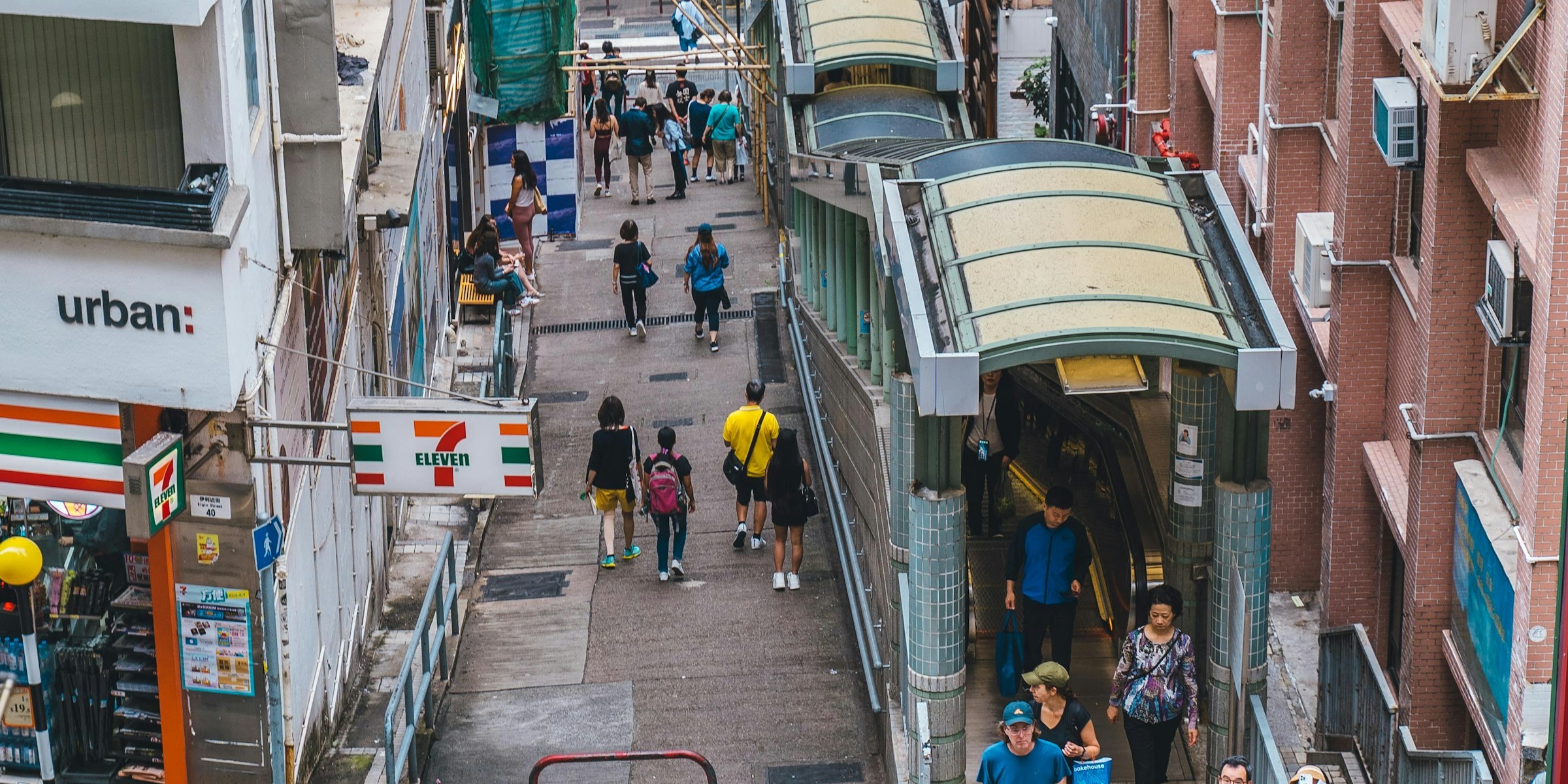
The Central–Mid-Levels Escalator is a public hillside transport system linking Queen’s Road Central with Conduit Road, and it is the same escalator network associated with the second story of Chungking Express. It is approximately 800 metres long and, per the Transport Department, runs downhill from 6:00 a.m. to 10:00 a.m. and uphill from 10:00 a.m. to midnight. (Hong Kong Transport Department, Hong Kong Tourism Board guide)
The system opened in 1993 and includes 16 escalators and three travelators. According to the Transport Department, it recorded roughly 99,000 trips per day in late 2024. It is managed as everyday transport infrastructure, so the experience is less like entering a landmark and more like joining a moving public route through Central and Mid-Levels.
The operating direction is important:
- Downhill: 6:00 a.m. to 10:00 a.m.
- Uphill: 10:00 a.m. to midnight
For a film-location walk, beginning in Central after 10:00 a.m. usually makes the route easiest. Start near Queen’s Road Central, follow the escalator uphill and step off whenever a side street, market, café or architectural detail interests you. You can ride only part of the route; there is no need to complete the full system.
The escalator is useful for understanding the film’s setting because it connects movement with observation. From the moving platform, you pass apartment entrances, restaurants, offices, bars, small shops and sloping lanes at eye level. The journey changes gradually rather than presenting one fixed viewpoint.
Graham Street Market is an optional stop in the Central section. It adds a grounded look at food shopping and neighbourhood commerce, and it has also been included in location guides covering the film’s then-and-now places. The area around the former Midnight Express site is nearby, including Lan Kwai Fong and D’Aguilar Street. The snack bar itself no longer operates, and visitors should not expect to find the original counter.
The Central walk is best treated as an urban culture route. The escalator carries commuters, students, residents and visitors; the surrounding lanes support daily work and shopping. That ordinary use is precisely what makes the place meaningful for a film-location itinerary.
How do you fit a Chungking Express walk into a Greater Bay Area China trip?
A practical Chungking Express day combines Tsim Sha Tsui in the morning or early afternoon with Central and Mid-Levels later, then continues as part of a wider itinerary through the Greater Bay Area, the cluster of Hong Kong SAR, Macau SAR, Guangzhou, Shenzhen, Zhuhai and Foshan. Hong Kong SAR is a separate immigration jurisdiction within China, so crossing plans should be checked separately from the film route. See the Hong Kong travel guide for a China trip and Hong Kong to mainland China crossings guide.
A simple walking sequence is:
- Begin at Tsim Sha Tsui MTR station.
- Walk to Chungking Mansions on Nathan Road.
- Spend time observing the building’s shops and food businesses without obstructing working areas.
- Continue through Tsim Sha Tsui or take the MTR toward Central.
- Start the Central–Mid-Levels Escalator near Queen’s Road Central.
- Pause around Graham Street Market or nearby lanes.
- Walk through the Lan Kwai Fong and D’Aguilar Street area associated with the former Midnight Express neighbourhood.
- Finish in Central, where onward transport can connect with the rest of your Hong Kong SAR stay.
The route works well before or after other interests. Travellers following a Hong Kong film and martial-arts theme can pair it with the Bruce Lee and Ip Man real-places guide, then continue toward Foshan. Travellers planning several cities can use the Greater Bay Area transport guide to connect Hong Kong SAR with Guangzhou, Shenzhen, Zhuhai, Macau SAR or Foshan.
This is also a useful day for visitors who want a culture-focused Hong Kong experience without filling the schedule with formal attractions. The route is mostly about public streets, working buildings, transport infrastructure and neighbourhood businesses. Wear comfortable shoes, keep the timing flexible and allow for weather, crowds and short pauses.
If your itinerary continues into mainland China, keep hotel nights and crossing days clear enough to accommodate immigration procedures and transport changes. The Hong Kong SAR, Macau SAR and China visa guide covers entry planning separately, so this article focuses on the film locations themselves.
How do Independent and Private Guided trips include these Hong Kong locations?
LocalKey can include Chungking Mansions, the Central–Mid-Levels Escalator and the former Midnight Express neighbourhood in either an Independent or Private Guided China itinerary. LocalKey arranges Hong Kong SAR hotels and transfers directly — and private guides when you choose Private Guided or add a guide on Independent — with the route adjusted around your wider Greater Bay Area plans.
Choose Independent if you want the flexibility to explore the locations at your own pace. A local guide is available as an optional add-on only, while LocalKey can still coordinate the practical structure around your hotel, transport and onward crossings.
Choose Private Guided if you want a specialist to connect the film’s locations with Hong Kong history, architecture, food culture and the rest of your China route. A private guide can explain what has changed, identify the relevant streets and help the day flow smoothly between Tsim Sha Tsui and Central.
Both tiers can be shaped around a short Hong Kong SAR stay or a longer route through the Greater Bay Area. The itinerary may combine this walk with other Hong Kong culture experiences, a Foshan extension or a broader China journey through Guangzhou and Shenzhen.
The goal is a useful location day rather than a checklist. You can pause at the places that interest you, leave room for meals and neighbourhood observation, and connect the walk with hotels and transfers suited to your schedule. LocalKey helps build your own China trip — planned, booked and backed.
To discuss the route, contact a 1:1 specialist for an Independent or Private Guided plan. Hong Kong SAR nights and walks are arrangeable, with 7×24 WeChat/WhatsApp support during the journey. Explore the Private China Tours overview or choose the Independent and Private Guided tiers.
For a related Kowloon density and neon culture story, see Cyberpunk Hong Kong: Neon, Density and the Kowloon Walled City Story.
Sources
All sources verified on 2 October 2026.
- Chungking Express: film basics and locations — verified 2 October 2026
- BFI: Wong Kar-wai and the locations of Chungking Express — verified 2 October 2026
- Filmmaker Magazine: Wong Kar-wai interview — verified 2 October 2026
- Time Out Hong Kong: then-and-now film locations — verified 2 October 2026
- Hong Kong Transport Department: Central–Mid-Levels Escalator — verified 2 October 2026
- Hong Kong Tourism Board: Central–Mid-Levels Escalator — verified 2 October 2026
- Hong Kong Tourism Board: Chungking Mansions — verified 2 October 2026
- Chungking Mansions background — verified 2 October 2026